
Shorebirds
Life Histories and
Human-Avian Dynamics
JUMP TO
AM. OYSTERCATCHER • HUDSONIAN WHIMBREL • PIPING PLOVER • RED KNOT • KILLDEER
Research by Hannah Escalante
American Oystercatcher • Haematopus palliatus •
American Oystercatcher • Haematopus palliatus •
American Oystercatcher
Haematopus palliatus
Order Charadriiformes, Family Haematopodidae
IDENTIFICATION
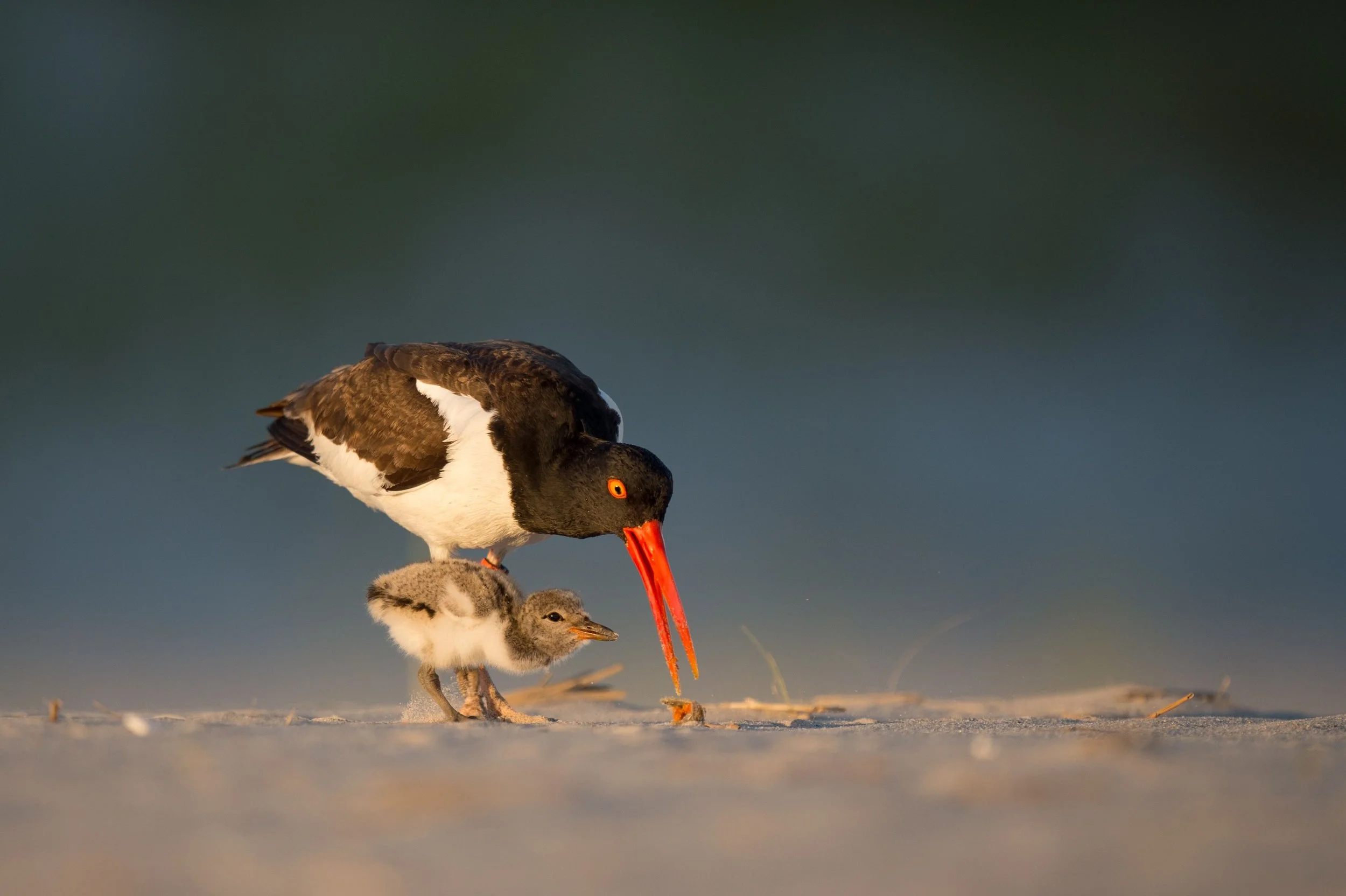
❋ DescriptionDark head, white breast, and brown feathering on back. Long, straight, bright red to orange bill. Long, pale pink legs with no hallux. Bright yellow iris with red eye ring. Frequently walks or runs rather than flying.
❋ CallMonosyllabic “kleep” or “peep.” Will use pipping calls in courtship (see sexual behavior).
❋ DimorphismMales and females visually indistinguishable.
❋ JuvenilesHave varying degrees of dusty orange to gray on bill and pale-fringed back feathers until fully mature.
❋ FeedingSpecializes on bivalve saltwater mollusks. Use directed, alternating left and right turns to search for food with beak submerged in sand. May exhibit probing behavior when searching for worms and clams. When feeding on bivalves, they will locate food visually. When a bivalve with open valves is found, they will “stab” it, inserting their knife-like bill into the open valves. With several quick thrusts, the two valves are broken apart. American Oystercatchers also use a “hammering” technique, in which they will move an individual bivalve above the water, orient it properly, and hammer into it with their bill. Nocturnal foraging is not observed.
DISTRIBUTION
❋ PopulationInternational estimate of ~43,000.
❋ Range
Can be found along the American eastern coast from New Jersey to Florida and along the Gulf coast. Also found on the coasts of Central America and South America, as far southward as the southern tip of Argentina. Eastern oystercatchers winter in large flocks from Virginia south along the Atlantic and Gulf coasts. Virginia, North Carolina, and South Carolina are key breeding and wintering areas for the species.
❋ MigrationConsidered partially migratory. Breeding birds from South Carolina to Florida as well as Central and South America are generally non-migratory, but will leave breeding territories to join local roosting flocks during the non-breeding season. Northern populations use “leapfrog” migration, often bypassing Atlantic coastal sites to winter on Florida’s northwest coast. Are highly individual and do not migrate in family groups.
❋ HabitatTied to coastal salt marshes and along sand beaches. Also breeds on dredge spoil islands.
-
Least Concern according to the IUCN. Species of High Concern according to the U.S. Shorebird Conservation Plan.
-
Sexual Behavior
Typically monogamous, but polygamy and communal nesting have been observed due to limited nesting habitat. Both sexes will exhibit “piping” behavior, in which they will walk parallel and utter a single “pipe” note. They will then stretch neck down, then run side- by-side with their mate. They will bob their heads up and down, giving a loud piping call, notes becoming more rapid and changing pitch over time. This ceremony may involve three or more pairs.
Nesting
Typically nests are placed in areas with little to no vegetation. Clutch is usually three eggs, but up to six have been observed. Will lay repeat clutches when nests are destroyed or young die early.
Parental Care
Precocial young. Both parents feed young, but males feed young slightly more frequently than females.
-
Erosion of upland areas of islands that result in lower profile bars may temporarily increase available nesting habitat. However, rising sea levels may have long-term negative effects.
-
This species typically inhabits coastal areas where human disturbance and habitat loss are threats; however, many groups and reserves work to protect these areas. Recreational activity and coastal development are major threats for this species.
-
South Carolina has approximately 400 pairs of nesting oystercatchers, with major threats including overwash of nests, disturbance, coastal development, and predation. The state is a significant wintering area and, for those not flying directly to Florida, are likely to winter on the South Carolina islands. SCDNR is part of the American Oystercatcher Working Group, including research such as nest monitoring, banding and resighting, and radiotelemetry. DNR counted eight nests with the restoration of Crab Bank in 2022.
Hudsonian Whimbrel • Numenius hudsonicus •
Hudsonian Whimbrel • Numenius hudsonicus •
Hudsonian Whimbrel
Numenius hudsonicus
Order Charadriiformes, Family Scolopacidae
IDENTIFICATION
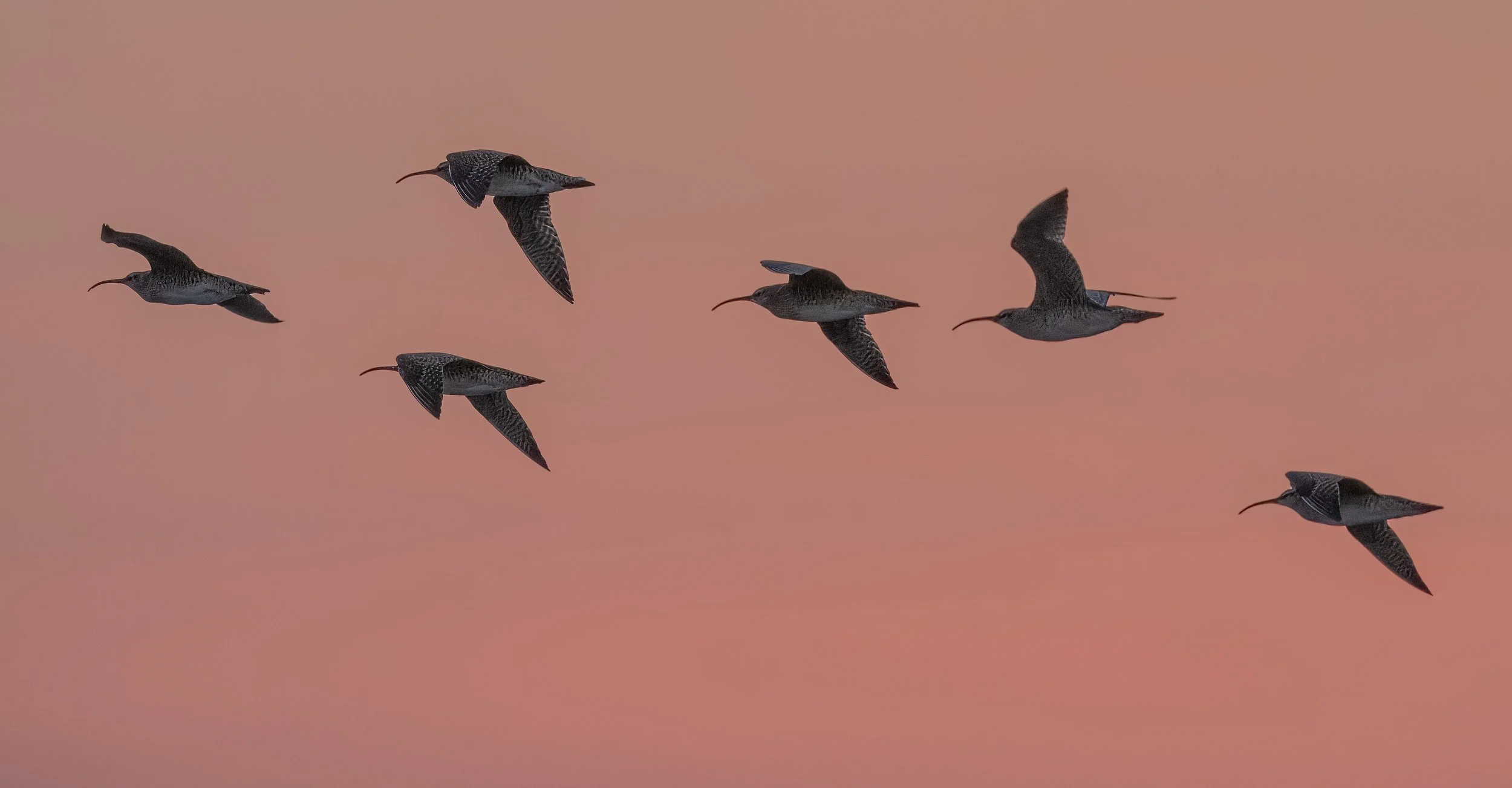
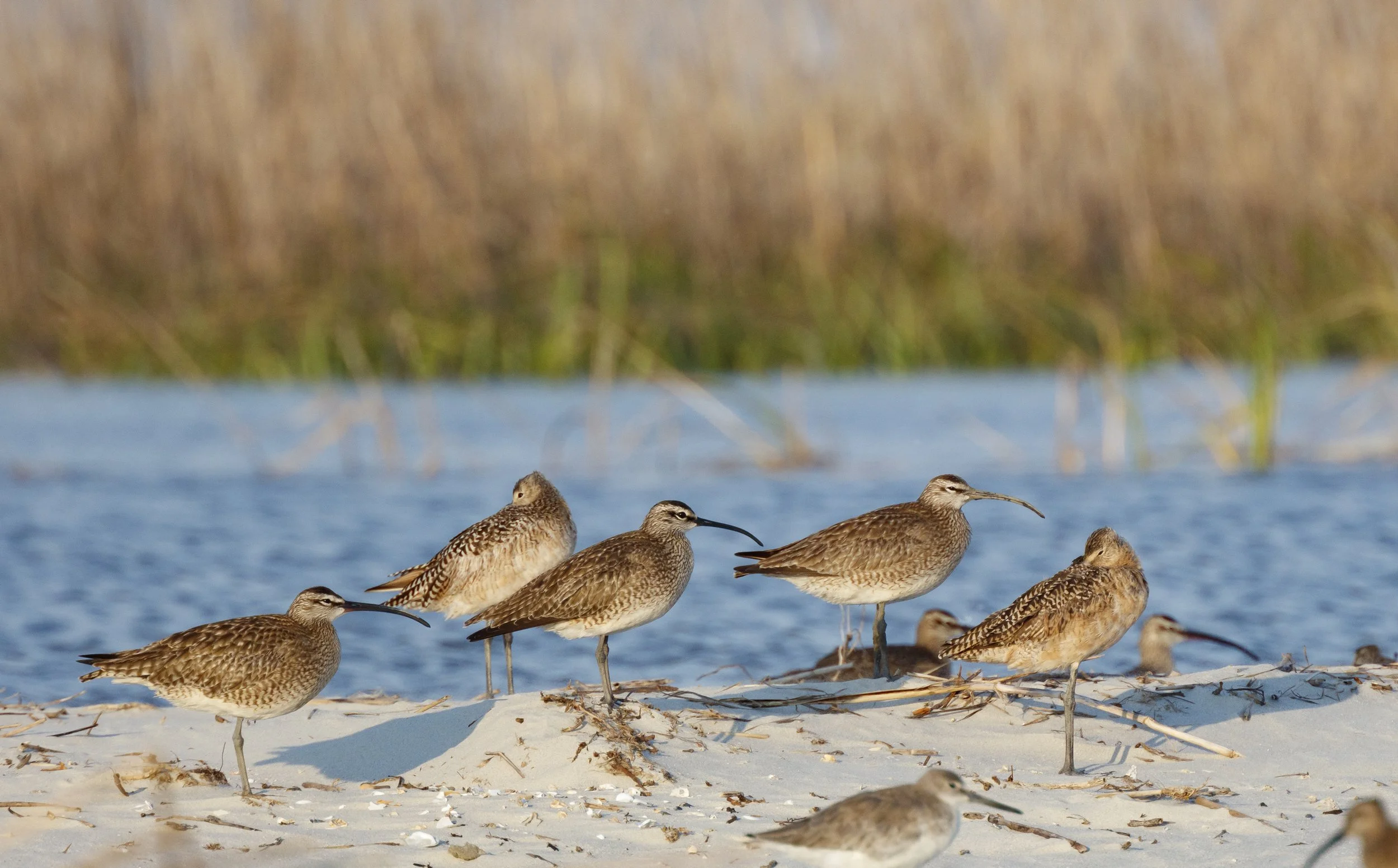
❋ DescriptionMedium-sized curlew with a long, decurved bill. Upperparts are dark brown, marked with pale buff. The underparts are pale buff. The neck and breast are streaked with dark brown. Has a blackish-brown crown with a pale central stripe.
❋ CallExhibit a range of calls, with low whistles, low trills, whining calls, short “whits,” etc. Not easily distinguished by call due to variety.
❋ DimorphismSexes are similar in plumage; no seasonal variation. Females are slightly larger than males. Females migrate before males.
❋ JuvenilesHave a slightly finer streaking on the breast and broader buff markings.
❋ FeedingFeeding varies depending on habitat. Use long, decurved bills to feed on marine invertebrates during migration and in the nonbreeding range via pecking and visual cues. Feed on lichens, mosses, and berries on breeding grounds. They typically forage in small groups or alone. May defend feeding territory on nonbreeding grounds. Feeds in daytime.
DISTRIBUTION
❋ PopulationInternational estimate of 90,781 as of 2012. More data is needed to refine our understanding; however it seems that this species is in decline.
❋ RangeThe western population breeds from coastal Alaska to northwestern Canada. The eastern population breeds west and south of Hudson Bay in Canada. Nonbreeders can be found from South Carolina down to the Gulf coast as well as along coastal Central and South America.
❋ MigrationA remarkable long-distance traveler. Coastal stopover areas are critical during migration - a critical site being in Charleston, SC. After breeding in northwest areas in Canada and Alaska from May-June, they will make transoceanic flights to nonbreeding grounds on the coast of South America.
❋ HabitatPrimarily coastal during migration and nonbreeding season. Have diverse habitats depending on location - can be found in tundras, grasslands, salt-dominated habitats, and freshwater habitats. Very territorial.
⛶ Gately Williams
-
In 2025, Whimbrels experienced a taxonomic split - now distinguishing the Hudsonian Whimbrel from the Eurasian Whimbrel. Because of this recent change, conservation status is not available. Before the taxonomic split, Whimbrels were classified as Least Concern by the IUCN. However, it is widely considered a species of concern due to significant population declines. Climate change: Alterat
-
Sexual Behavior
Monogamous and territorial. Chases between males occur prior to territory establishment. Male courts female via an aerial display and a song. Mate chasing also occurs.
Nesting
Composition and location depends on varying habitat. Clutch size is typically four eggs.
Parental Care
Parents share incubation duties. Precocial young.
-
Alteration of habitat and prey availability may influence this species.
-
Until 1918, sport and market hunters posed the greatest threat to this species. After the Migratory Bird Treaty, the species population began to rise again. However, the Hudsonian Whimbrel is still hunted in parts of South America, the Caribbean, Mexico, Alaska, and Canada. They are also commonly shot to protect berry crops in their respective habitats. Another increasing threat are environmental contaminants, including untreated mining wastes in northern Chile and DDE in Alaska. To further understand conservation of this species, continual monitoring and gathering of data must occur.
-
Deveaux Bank (including other islands in the area) has been a key stopover site for this species in the spring. One may see a Whimbrel feeding on fiddler crabs in a Charleston mudflat that will migrate to the Arctic within days. This stopover is particularly notable for the remarkable abundance of Whimbrel observed, especially knowing the species’ ongoing population decline. A story by Scott Weidensaul, featured in the Cornell Lab of Ornithology in 2021, beautifully describes “A Miracle of Abundance as 20,000 Whimbrel Take Refuge on a Tiny Island.”
Piping Plover • Charadrius melodus •
Piping Plover • Charadrius melodus •
Piping Plover
Charadrius melodus
Order Charadriiformes, Family Charadriidae
IDENTIFICATION
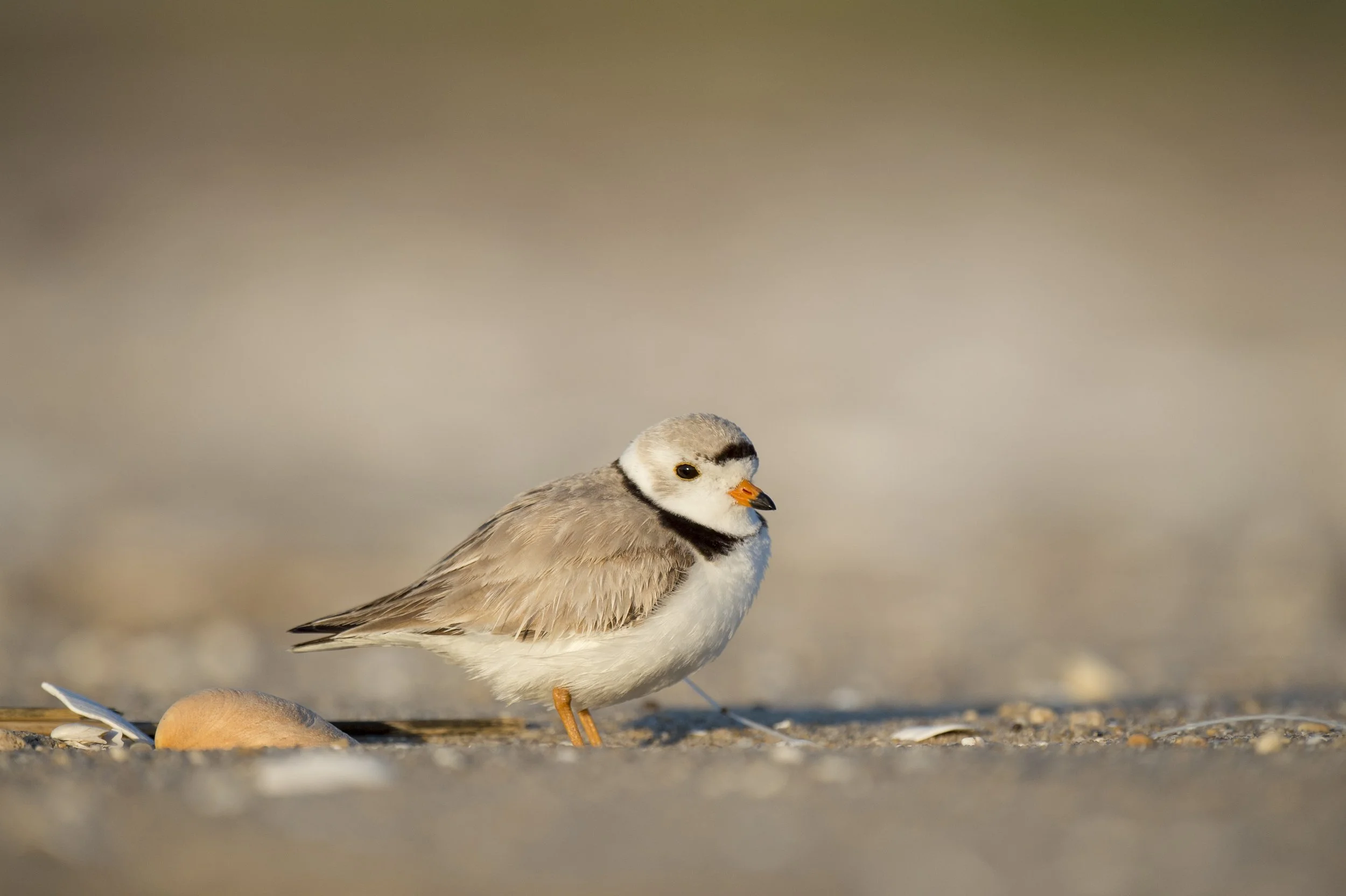
❋ DescriptionSmall, round, and stocky with yellow legs, a white underside, and a sandy grey back. In the summer, they will have orange bills and orange legs.
❋ CallHigh-pitched “pipe-pipe-pipe.” Alarm calls have been described as a drawn out “woo-up.”
❋ DimorphismMales will have a black or dark ring around the neck with a bill that has a slight yellow base when in breeding plumage.
❋ JuvenilesStill round and stocky with yellow legs, white underside, sandy grey back, and all black bill. Can have a partial brown or grey ring around the neck.
❋ FeedingEat aquatic invertebrates including marine worms, small crustaceans, flies, water beetles, snails, roundworms, and others. This species uses a run-stop-run method interspersed with rapid pecks; this occurs so quickly that it appears to be random probing rather than specific, direct pecks. They have also been observed to extend one foot slightly forward and vibrate it against water-saturated sand to bring invertebrates to the surface. Typically forage alone or in small groups (but not cooperatively). Active during all hours of the day.
DISTRIBUTION
❋ PopulationIn the 2001 international breeding census, an estimate of 5,945 birds were described - a very low number for a species with such a widespread distribution.
❋ RangeBreeding populations are found from the northeastern coast down to North Carolina as well as in the Great Plains and Great Lakes. Non-breeding populations are found along the coast of the southeastern United States from South Carolina, along the Gulf coast and east Central American Coast (as far down as Belize).
❋ MigrationMid-distance migrant. Inland breeders appear to migrate nonstop to the Gulf of Mexico or Atlantic Coast. Some Atlantic birds take breaks at stopover sites to refuel. Post- breeding populations migrate southward along the east coast, down as far as Belize. Fall migration begins in the late summer; Spring migration occurs from February to April as they return to breeding territory.
❋ HabitatSandy and muddy shores along oceans, lakes, rivers, and wetlands.
-
Near Threatened according to the IUCN.
-
Sexual Behavior
Monogamous for the breeding season, but often change mates in following seasons. Males court females by tipping side to side while in flight alongside deep, slow wingbeats above their territories. They will also tilt their bodies and spread their wings and tails on the ground.
Nesting
Make nests in loose sand above the high tide line. Males use feet to make several small depressions in the sand. They will take several days to decide which depression to use as a nest, but when they do, they line it with small shells or rocks.
Parental Care
Both parents share incubation duties. Precocial young.
-
As they are already threatened, increase in sea levels and storm intensity can easily add to the habitat and nesting loss that is already occurring.
-
iping Plovers are of concern due to habitat loss from coastal development, human disturbance on beaches, and high predation rates by gulls, crows, raccoons, etc. Broad-scale conservation actions have occurred, including formation of the International Piping Plover Recovery Group and other local efforts. Such efforts involve tracking changes in distribution and efforts, closing nesting sites, construction of predator exclosures, etc. Intensive management is not ideal and is often controversial, however techniques are constantly being assessed and refined.
-
South Carolina is an important stopover site for migrants. Though rarely breeding in the state, its shores provide critical habitat in the nonbreeding season. SCDNR and USFWS have partnered to band Piping Plovers to contribute to conservation efforts. They mainly inhabit the area in winter along inlets of barrier beaches and uninhabited islands.
Red Knot • Calidris canutus •
Red Knot • Calidris canutus •
Red Knot
Calidris canutus
Order Charadriiformes, Family Scolopacidae
IDENTIFICATION
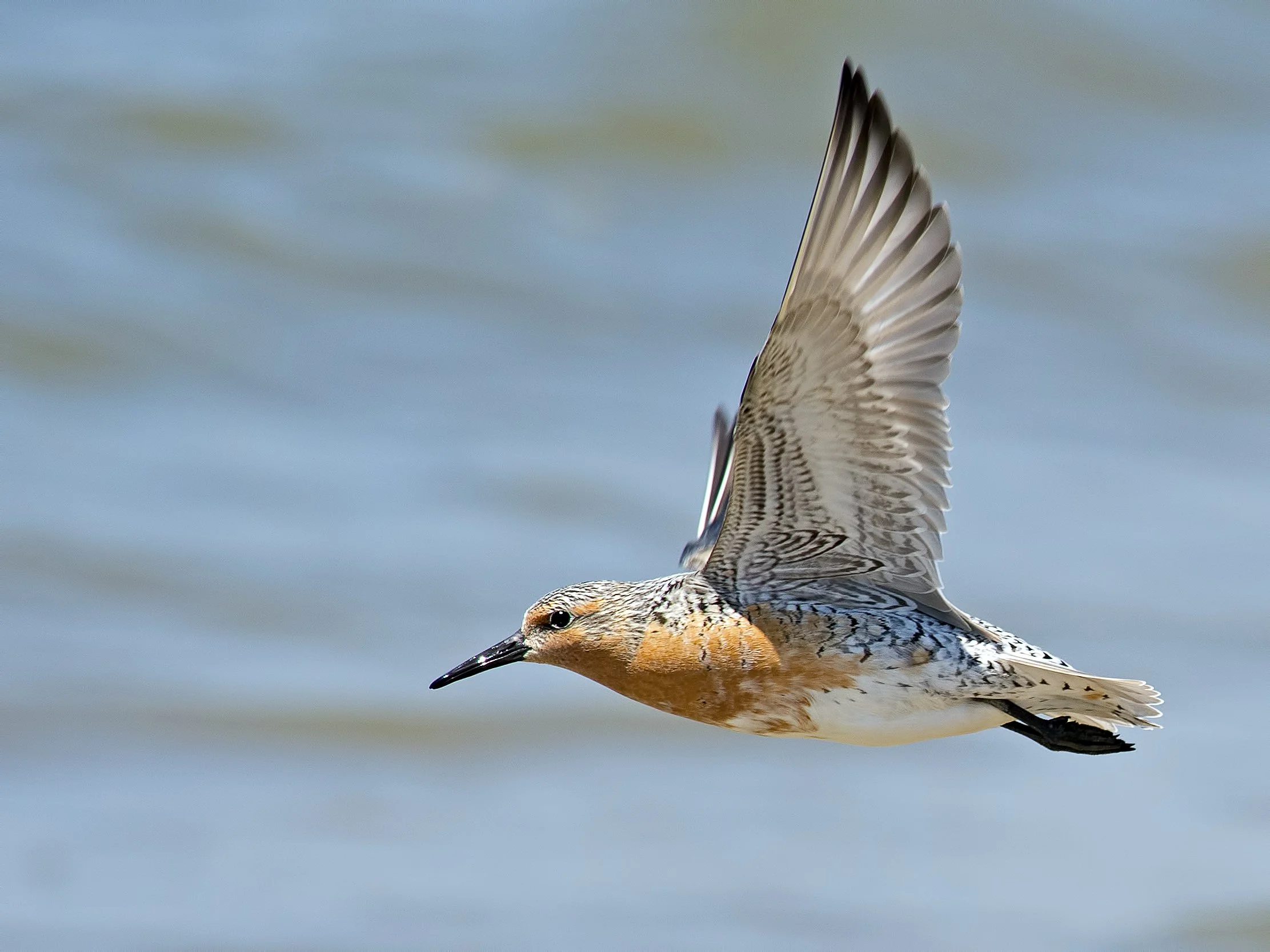
❋ DescriptionShort-necked, stocky, short, black bill. In flight, note the light rump & tail. Small head, small eyes, straightish bill tapering from thick base to thin tip. Rusty red breeding plumage, dull gray back and white belly in winter plumage. Medium-sized.
❋ CallLow buzzy whistle; “tlu-tlu.”
❋ DimorphismMales more brightly colored than females in breeding plumage. Females have less distinct eye-lines with lighter breeding plumage, occasionally with dark markings.
❋ JuvenilesDark bands on upper back feathers between wings. May show pale pinkish color on breast. Bill yellow and sometimes greenish.
❋ FeedingEats marine worms, small crabs, marine mollusks, bivalves; swallow whole and crush with muscular gizzard. Probe in a hunched posture. In late May during Spring migration, they stop at Delaware Bay to eat eggs of horseshoe crabs. Rarely forages alone.
DISTRIBUTION
❋ PopulationInternationally 891,000-979,000.
❋ Range
Breeds in the high Arctic of northern Alaska, northern Canada, and Greenland. Also breeds in northern regions of Russia. Has a wide nonbreeding range, populations found along the western and eastern coasts of the Americas, western coast of Africa, coastal India, and coastal Australia and New Zealand.
❋ MigrationLong-distance migrators with relatively few stopover sites. Undertake annual migration spanning the western hemisphere coasts. Travel from middle and high-arctic breeding latitudes to the eastern Pacific and Atlantic coasts, including southernmost continental lands of South America and eastern Europe. Relies heavily on stopover sites.
❋ HabitatSandy shores, rocks, mudflats.
-
Near Threatened according to the IUCN. All knots are currently in decline around the world.
-
Sexual Behavior
Monogamous. Males present a “tail-up” display during courtship (tail not fanned) along with vocalizations. He will also prepare 3-5 nest scrapes in his territory before females arrive.
Nesting
Highly social; strong flocking observed. Nests in drier tundra and sparsely vegetated gravel.
Parental Care
Shared parental duties. Precocial young.
-
This is a serious concern for this species. The unpredictability of weather conditions and possible loss of Arctic breeding habitat could be detrimental to these long-distance migrators.
-
Horseshoe crabs are being increasingly protected in order to help preserve their relationship with the Red Knot. With loss of many habitats due to extensive habitat loss, many groups are working towards land preservation, some even contributing to land reclamation projects. Identification of important migration staging and wintering sites is key in ensuring the habitats of this species are protected.
-
South Carolina is a key habitat for migrating Red Knots as a stopover site as well as wintering Red Knots. Many remain in the area during the nonbreeding season. They are also known to feed on horseshoe crabs locally. SCDNR has banded many in the area for continued monitoring and research. Though large flocks may be observed on our beaches, any sort of disruption (joggers, dogs, beach combers, etc.) can cause them to expend energy that would be used for flight. Building up enough fat reserves for their long-distance journey is key for this species survival, and education and awareness are of top priority for Red Knot conservation.
Royal Tern • Thalasseus maximus •
Royal Tern • Thalasseus maximus •
Killdeer
Charadrius vociferus
Order Charadriiformes, Family Charadriidae
IDENTIFICATION
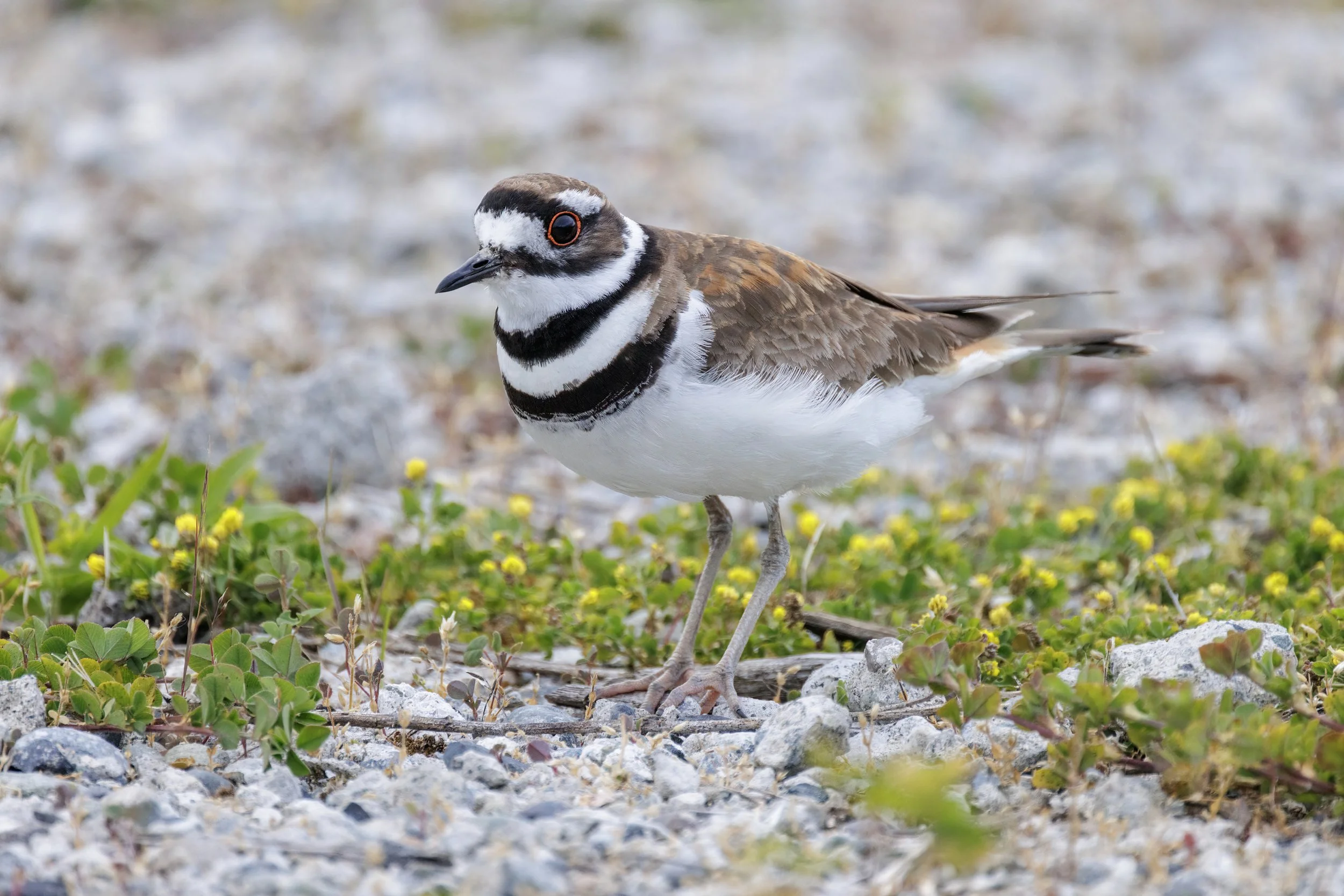
❋ DescriptionThe most widespread and common plover in North America with long legs, long and pointed wings, grayish brown upperparts, white underparts, and two black bands across the breast. Long tail with rump and uppertail brownish-red.
❋ CallVery vocal; a rising, moderately high-pitched and somewhat drawn out “kill-deer.” “kill- dee,” “dee.” or “dee-ee.”
❋ DimorphismNo observed dimorphism.
❋ JuvenilesOnly have one black breast band.
❋ FeedingEats terrestrial invertebrates, including earthworms, grasshoppers, beetles, and snails. Forages in a “run-stop-bob pattern,” in which they will run, stop and pat the ground with one foot with quivering motion - this is theorized to draw out prey. They will probe to capture prey, and may chase moving prey. Diurnal.
DISTRIBUTION
❋ Population~2,300,000. In 1993, it was estimated that 100,000 Killdeer occur in Canada and that populations are stable in the Pacific region, possibly stable in the central region, and possibly declining in the eastern region.
❋ RangeFrom the Northwest Territories of Canada, to every single state in the United States, through the entirety of Central America and the Caribbean to northern Colombia and Venezuela. Also found on the coast of Ecuador and Peru.
❋ MigrationNorthern populations are migratory, migrating south during the winter; southern populations are residential.
❋ HabitatCan be found in a large range of open habitats. Mudflats, gravel bars, short-grass meadows; construction sites, road shoulders, gravel roads, driveways, and rooftops, lawns, pastures, and golf courses. Often found near water access, even near sprinklers.
-
Near Threatened according to the IUCN, but Least Concern according to Audubon. See Human-Avian dynamics. A slow, but consistent decline has been noted.
-
Sexual Behavior
Monogamous. During courting, they will pick out a nesting site through a ritual known as a “scrape ceremony” in which they will exhibit complex aerial displays and bow on the ground, fanning their tails.
Nesting
Typically lay four eggs. Begins in early spring - March in the deep south, April in the middle states, May in the north into southern Canada, and June in their northernmost range. Will nest year-round in the Caribbean.
Parental Care
Both sexes share incubation duties, however males will incubate more at night. Will fake being injured in order to draw away predators from the nest. Highly precocial young.
-
Increase in wildfires, shifting ecosystems, and extreme temperatures could endanger the nesting habitat of Killdeers - especially as ground nesters.
-
Was once the target of market hunters; now, incredibly widespread and tolerant of humans and disturbance. Despite this, they are still sensitive to other issues such as pesticides, oil pollution, and other pollutants due to their diet and close association with humans. Shooting and trapping still occurs despite its illegality, still frequently killed by hunters who mistake them for Mourning Doves. Additionally, this species was historically confined to coastal regions and sandbars of major rivers; as more forested areas became open due to habitat alteration by humans, Killdeer expanded their habitat range. This has resulted in heavy reliance on human-modified habitats, leading to increases in collisions, pollution exposure, nest destruction, etc.
-
Killdeer inhabit the area throughout the year, serving as an important area for breeding, migration, and wintering. Population occurs across the state in a variety of open habitats. One of the most common shorebirds in the area.