
Seabirds
Life Histories and
Human-Avian Dynamics
JUMP TO
BLACK SKIMMER • BROWN PELICAN • LAUGHING GULL • LEAST TERN • ROYAL TERN
Research by Hannah Escalante
Black Skimmer • Rynchops niger •
Black Skimmer • Rynchops niger •
⛶ Mathew Schwartz
Black Skimmer
Rynchops niger Order Charadriiformes, Family Laridae
IDENTIFICATION
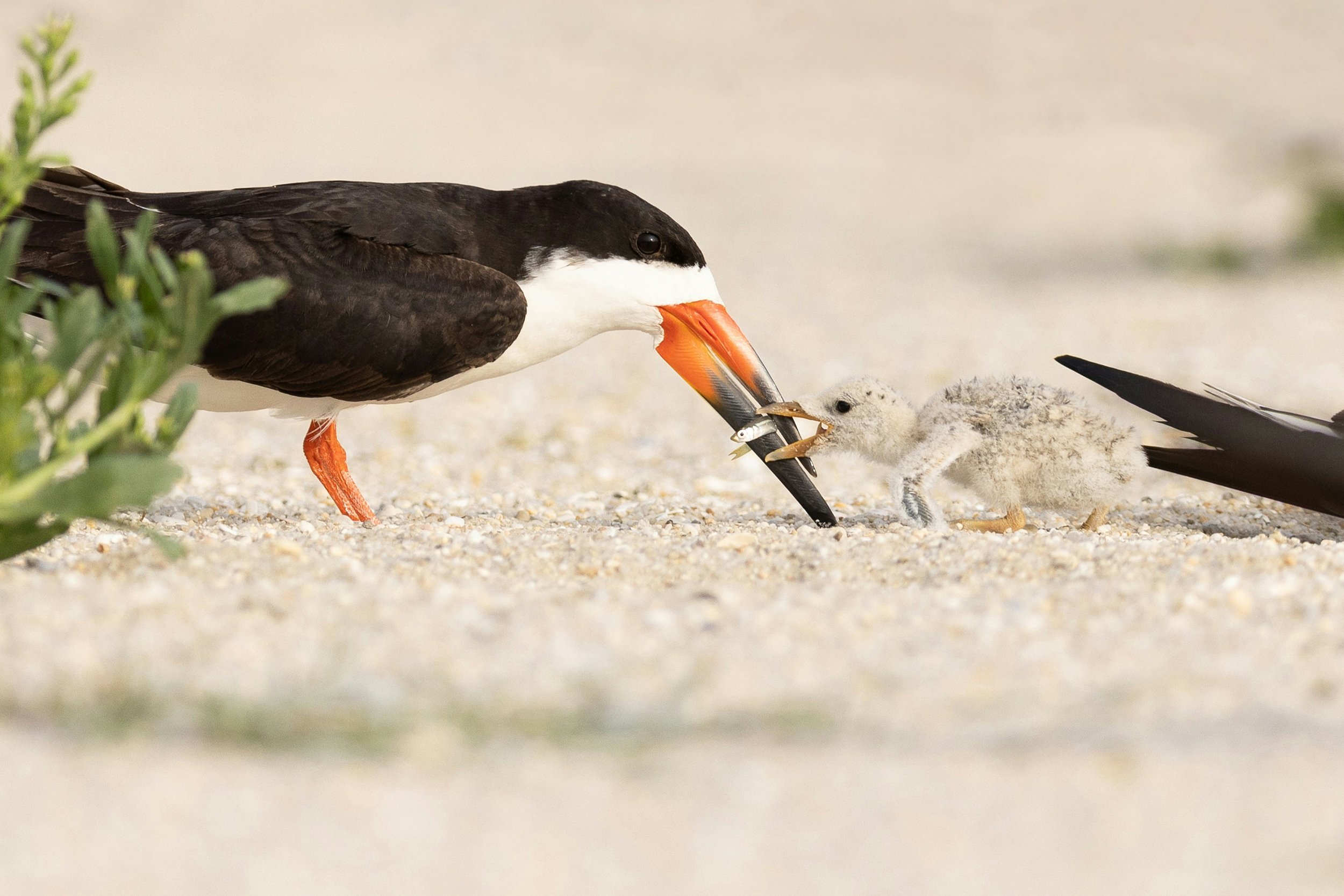
❋ DescriptionKnife-like bill is black at the end but bright red towards head. Medium-sized, narrow-bodied. Body is blackish above and white below with a white tail. Red-orange, webbed feet. The eye is typically invisible due to surrounding black feathering.
❋ CallDog-like; “Barks.”
❋ DimorphismMales typically have larger bills than females. Many males have a narrow, visible slit between the mandibles.
❋ JuvenilesHave some brown, with black streaks above and white below.
❋ FeedingBill shape adapted to catch small fish in shallow water, hence their name. Skimmers fly low over the water with their bill open and lower mandible skimming the surface. When the mandible touches a fish, their upper bill (maxilla) snaps down to catch it. Crepuscular and nocturnal.
DISTRIBUTION
❋ PopulationIn decline (as of 2026). The North American Waterbird Conservation Plan estimates the North American population to be 65,000-70,000
❋ RangeYear-round this species is found along the eastern coast of the United States from Massachusetts to Florida, extending west to the Texas coast. Small breeding populations exist in California. Past Florida, Black Skimmers can be found as far south as northern Argentina.
❋ MigrationThis species is partially migratory. Large concentrations found in North Carolina, South Carolina, and Florida in the winter. Populations from the southeastern U.S. may move only short distances. Northern breeding populations are the most migratory, leaving their nests in the late summer and fall to spend their winter as far as northern Argentina.
❋ HabitatMainland coast or barrier islands on sandy beaches, sandbars, shell banks, dredge islands, mudflats, and wetlands.
-
Least Concern according to the IUCN; often classified as threatened, endangered, and special concern locally due to loss of breeding habitat.
-
Sexual Behavior
Monogamous. Mate guarding has been observed, where males become more aggressive towards intruders when mate is present. In courtship, male presents fish to female.
Nesting
Highly social. In breeding season, they nest in colonies; outside of breeding season, they form large flocks. Also known to nest near terns. Typically found nesting on beaches, bars, dredge deposition, salt marsh, and rooftops (in Florida since 1986). Will breed inland when water levels are lowest, then move to coastal areas when river flooding occurs.
Parental Care
Both sexes incubate. Chicks hatch semi-precocial.
-
In southern Florida, an increase in tropical storms have disrupted Black Skimmer colonies. Coastal erosion and sea-level rise also contribute to loss of habitat.
-
In the mid-1800s, skimmers were hunted for their eggs. However, thanks to the U.S. Migratory Bird Treaty Act, this species along with other birds listed are protected. Despite this, human disturbance is still a major issue. Disturbance such as habitat modification, dogs, vehicles, noise pollution, and nest destruction (purposeful or not) lead to lower hatching success, nest abandonment, etc. Protection and monitoring of breeding and nesting sites are crucial to survival of this species.
-
During spring and summer, this species nests in colonies on barrier islands, sandy beaches, sandbars, etc. Beginning in August, South Carolina becomes an important staging area where flocks gather before they continue migrating southward for winter. Through a public- private partnership with DNR, Audubon South Carolina, Coastal Conservation League, and Coastal Expeditions, one such nesting and staging area - Crab Bank - was restored with harbor dredge material in 2021. The following year, nesting success skyrocketed with 237 skimmer nests counted. Though still considered in decline and a species of high concern in Charleston, efforts such as these are key conservation success stories.
Brown Pelican • Pelecanus occidentalis •
Brown Pelican • Pelecanus occidentalis •
Brown Pelican
Pelecanus occidentalis Order Pelecaniformes, Family Pelecanidae
IDENTIFICATION
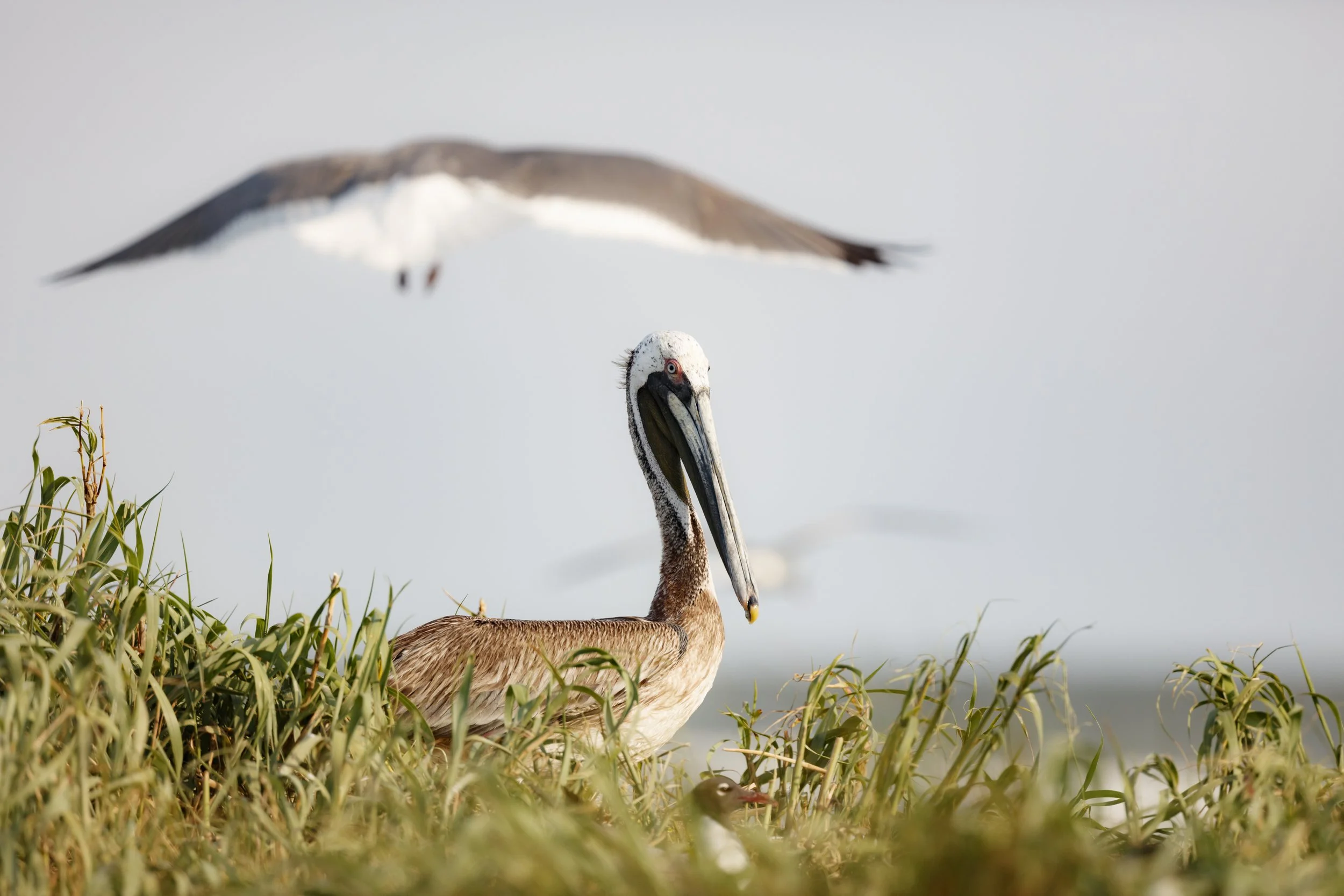
❋ DescriptionA popular, recognizable seabird; has a large body, long bill, and conspicuous gular pouch. Has webbing between all four toes (totipalmate). Very long-lived; up to 40 years.
❋ CallDo not have a syrinx; instead, make a low, hoarse “hrraa-hrraa” sound passively. Will also make loud popping sounds in the gular pouch when mandibles snap together during aggression.
❋ DimorphismThe head and neck are pale yellow outside of breeding season; the head is white and the neck is brown during breeding. During courtship, gular pouch appears blackish metallic green (bright red in western North America).
❋ JuvenilesAppear similar to adults.
❋ FeedingDive head first and trap fish in their expandable gular pouch (“surfance plunging”). Primarily forages in shallow waters of estuaries and continental shelf. Typically in the early morning and evening on rising tides. Vulnerable to kleptoparasitism (stealing food from another animal) by gulls and terns while draining gular pouch prior to swallowing prey.
DISTRIBUTION
❋ PopulationInternationally, 344,930-399,400
❋ RangeConcentrated along the coast of the Americas, including the Atlantic, Pacific, and Gulf coasts and extending southward to northern South America. Breeding populations are concentrated along the Atlantic coast from Maryland to Florida, throughout the Gulf of Mexico, and to the northern border of South America. Also found along the Pacific coast from California to Mexico.
❋ MigrationUnlike many coastal birds, Brown Pelicans are considered to be residential or short-distance migrants. Postbreeding dispersal may occur in search of food along the coast, with juveniles typically traveling farther than adults. Northern populations are more likely to migrate southward, but southeastern populations are often residential.
❋ HabitatWarm coastal marine and estuarine environments year-round. Rare inland. Seek small, predator-free coastal islands.
⛶ Gately Williams
-
Least Concern according to the IUCN.
-
Sexual Behavior
Monogamous. Male gathers material and presents the nest to the female, also holding nest material for her to take to show her acceptance. He also performs a head swaying display.
Nesting
Highly social; breed in colonies of up to several thousand pairs. Normal clutch is one brood with 2-4 eggs per season. Typically nest on small estuarine or offshore islands to avoid disturbance and predation. Will defend nest by rapidly thrusting bill forward while snapping mandibles together, creating a loud popping noise.
Parental Care
Parents share incubation duties; Eggs are incubated underneath their foot webs. Altricial young. Young are fed predigested fish that the parents regurgitate.
-
Of particular concern on the west coast (though also in effect on the east coast), rapid loss of coastline habitat and nesting islands as well as flooding estuaries have resulted in habitat and nest destruction.
-
Was formerly hunted for meat and skins by Native Americans in the Gulf of California. Was shot for feathers for trade in the late 19th and early 20th centuries. Between 1950-1970, this species nearly became extinct in North America due to human-made organochlorine pesticides that entered the food web. The pesticide endrin killed pelicans directly; DDT resulted in thin-shelled eggs that would break under incubation. Are also highly prone to oil spills, due to breeding and foraging sites commonly being near heavy commercial traffic, refineries, etc. All of these factors contributed to its listing as Endangered until 2009. With the ban of DDT in 1972 and reduction of use of endrin, populations were able to recover. The Brown Pelican is a symbolic wildlife-conservation success story. Despite this, habitat degradation, disturbance, and fishing gear injury are still of concern.
-
The Brown Pelican is the state seabird of South Carolina - a permanent resident of the coastal islands. Breeds from Bulls Bay south to the mouth of the Savannah River. Pelicans used to be less common in the Lowcountry, with fewer than 2000 nests in SC in the early 1970s. However, as of 2018, 38% of all of the east coast’s nesting Brown Pelicans are in South Carolina. Like other birds in the area, habitat loss is always an issue.
However, with the restoration of Crab Bank, one will see thousands of Brown Pelicans nesting in Charleston!
Laughing Gull • Leucophaeus atricilla •
Laughing Gull • Leucophaeus atricilla •
Laughing Gull
Leucophaeus atricilla
Order Charadriiformes, Family Laridae
IDENTIFICATION
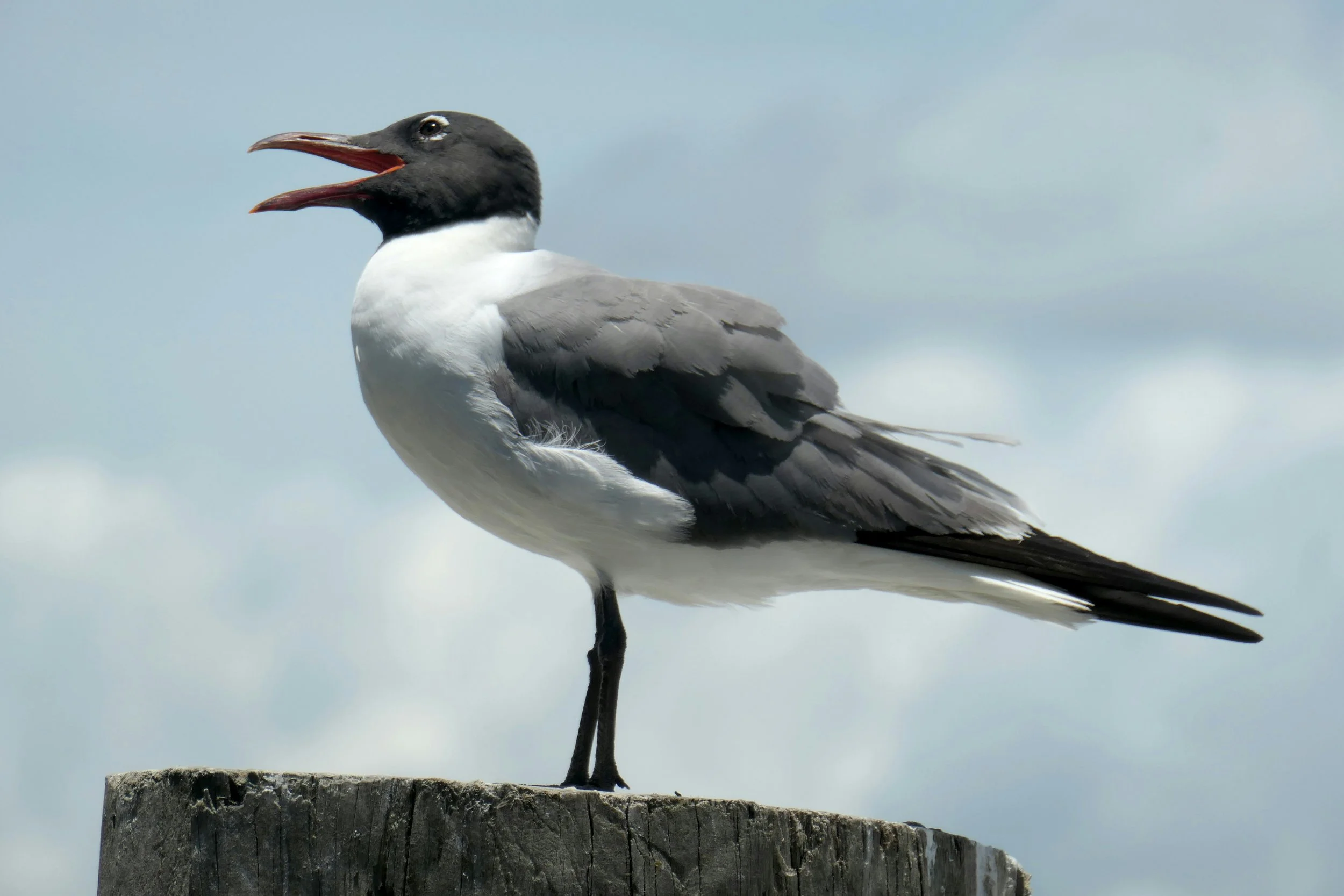
❋ DescriptionAn iconic, incredibly social species common to the coast. Have dark gray mantles, a black head, and dark eyes ringed with narrow white eye-crescents.
❋ CallNoisy; Laugh-like, hence the name!
❋ DimorphismNo known sexual or seasonal dimorphism.
❋ JuvenilesHead and body gray/dusty-brown. Paler on forehead, chin, and throat. The eye area hasa black crescent in front and whitish crescents above and below the eye.
❋ FeedingFeed on fish, crustaceans, worms, carrion, and garbage. In a typical coastal environment, they prefer to feed at the edge of the water; they will relocate inland during high winds and high tides. They will also feed up to 30km offshore on the Atlantic coast, and even further in the Gulf. May forage while walking and picking up food; swimming; walking in water; flying; or plunge-diving. It has also been observed that gulls may forage alongside Brown Pelicans, hovering over them or sitting on their back to catch escaping prey. Diurnal.
DISTRIBUTION
❋ PopulationCurrently the most abundant breeding seabird along the United States east coast.
❋ RangeFrom the most northeastern US coastline to Florida and the Gulf coast. Extends down east and west Central and South America as far as northeastern Brazil and southern Peru. Also throughout the Caribbean and the east and west coast of Mexico.
❋ MigrationPartially migratory. East coast gulls will migrate south down the Atlantic and Gulf coasts to South America. Pacific coast gulls will disperse to southern California and migrate south to winter from southern Mexico to Peru. Many southern and southeastern gulls (including in South Carolina) will remain year-round. Wintering birds are found throughout its range.
❋ HabitatWide range of habitat. Harbors, estuaries, coastal lagoons, dredge spoils, etc.; Sandy or rocky shores on saltmarsh islands.
⛶ Ilse Orsel
-
Least Concern according to the IUCN.
-
Sexual Behavior
Monogamous. Tosses their head and faces away from mates during courtship. Male will advertise with a series of long calls and head tosses and may continue to make this sound even with no females present to attract a mate.
Nesting
Nests in colonies of up to 25,000 pairs, arriving at their site in early to mid-April and
breeding from April to May. Typically lays three clutches. Though this species has a wide range of habitat, they prefer to nest in or near salt marshes (though other areas have been observed).This makes nest maintenance quite important in order to ensure a safe, well-constructed nest that is less susceptible to changing tides.
Parental Care
Parents share incubation and feeding duties. Semi-precocial young.
-
Sea-level rise could be of particular impact to Laughing Gulls; with preference to nest in salt marshes, an influx of water and increase in tides could disrupt and/or destroy nesting.
-
This species was removed from many coastal colonies in the late 1800s and early 1900s by eggers and the hat trade. Today, gulls are well-adapted to humans, as well as the food and habitat change that comes with them. This has posed an issue for aircraft, as gulls now feed on fields surrounding airports. This has resulted in selective removal of gulls near large airports, for example the JFK Airport in New York.
-
South Carolina’s ideal habitat supports substantial populations of Laughing Gulls during breeding, nonbreeding, migration, and wintering. They have also been found foraging on bycatch with shrimp trawlers on 90% of South Carolina surveys.
Least Tern • Sternula antillarum •
Least Tern • Sternula antillarum •
Least Tern
Sternula antillarum
Order Charadriiformes, Family Laridae
IDENTIFICATION
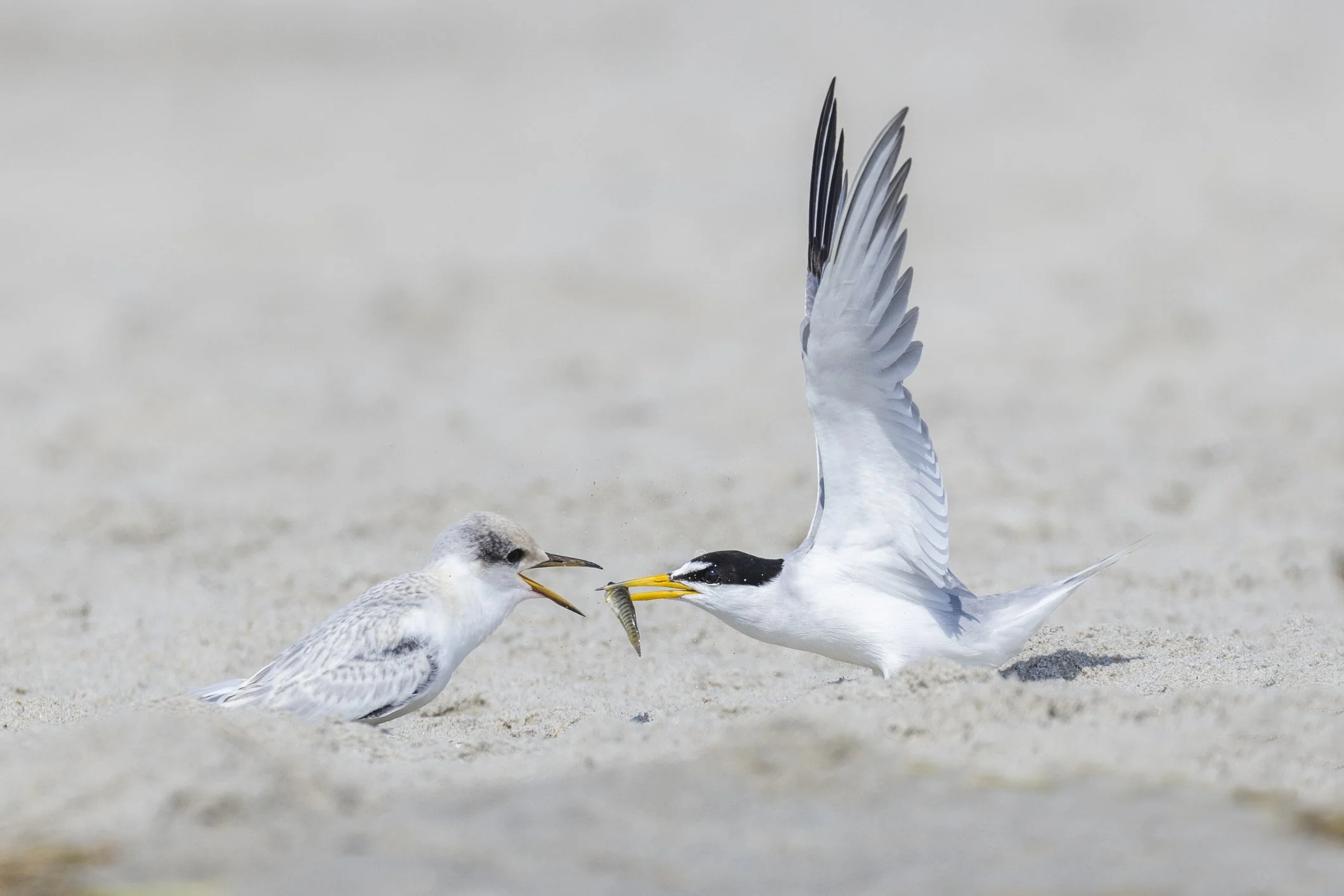
❋ DescriptionA small, social tern with a white and light gray body, white forehead, black cap, black stripe between the eye and bill.
❋ CallHigh pitched, squeaky “ki-dik.”
❋ DimorphismThe stripe between the eye and the bill is wider in males.
❋ JuvenilesHas dark U- or V-shaped markings on a gray to yellowish brown mantle.
❋ FeedingPrimarily eat small fish, however have been observed occasionally eating shrimp and other invertebrates. Forage in shallow water both on the coast and inland; Will plunge-dive to capture prey. Diurnal.
DISTRIBUTION
❋ PopulationVarying population numbers year to year; counts during the 1980s and 1990s estimated 55,000 Least Terns in the United States, however this number has decreased.
❋ RangeFrom New England to Florida coast, Gulf coast to central Mexico, Pacific coast from central California and south to central Mexico, northern coast of South America, and the Caribbean.
❋ MigrationFully migratory. After breeding, they leave North America and winter along the east coast of Mexico, east coast of Central America, northern coast of South America, and the Caribbean. Migration typically begins in late summer, returning to breed in the spring.
❋ HabitatNests on open sandy beaches, sandbars, unvegetated islands, and along the coasts of oceans, bays, inland rivers, large lakes, and alkali wetlands of the Great Plains. They have recently begun to breed on flat gravel rooftops - especially in disturbed areas.
-
Least Concern according to the IUCN. Currently threatened in South Carolina.
-
Sexual Behavior
Monogamous. Males will bring fish to females during courting, raising his head in triumph if female swallows fish.
Nesting
Nests in colonies. They choose several nesting options, both sexes making depressions called “scrapes” until the female decides on a singular nesting site; females construct unlined nests. Tend to nest on open beaches/areas, and will abandon their nests if overly disturbed. Will also construct nests in low-lying sandbars that, especially in South Carolina, are subject to flooding by high tides. Also nests with Black Skimmers. Typically have 1-3 eggs.
Parental Care
The female will take the majority of incubation and parental duties, however the male will incubate as well. Shake water on their eggs, cooling them as it evaporates. Semi-precocial young.
-
Susceptible to habitat loss and flooding, with primary nesting locations being close to water. Loss of shorelines could heavily reduce habitat availability.
-
In the early 20th century, the species was overhunted due to the hat trade. Least Terns are also known to abandon their nests if too much disturbance, which is unfortunately common due to their nesting preferences on open beaches. On wintering grounds, terns may be shot for food or sport. Additionally, due to their prevalent fish diet, bioaccumulated contaminants have potential for negative effects on these populations. Exposure to oil pollution is also a risk throughout their range. Due to their mobility, assessment and conservation management of Least Terns can be difficult.
-
The state provides ideal nesting habitat for Least Terns during the summer breeding season, with nesting terns found at 12 locations on the coastal islands of the ACE Basin. They have also been found to nest on the roofs of buildings, likely due to habitat loss and human disturbance.
Because they nest openly on beaches, SCDNR consistently works to post nesting signage and close off nesting areas.
Royal Tern • Thalasseus maximus •
Royal Tern • Thalasseus maximus •
Royal Tern
Thalasseus maximus
Order Charadriiformes, Family Laridae
IDENTIFICATION
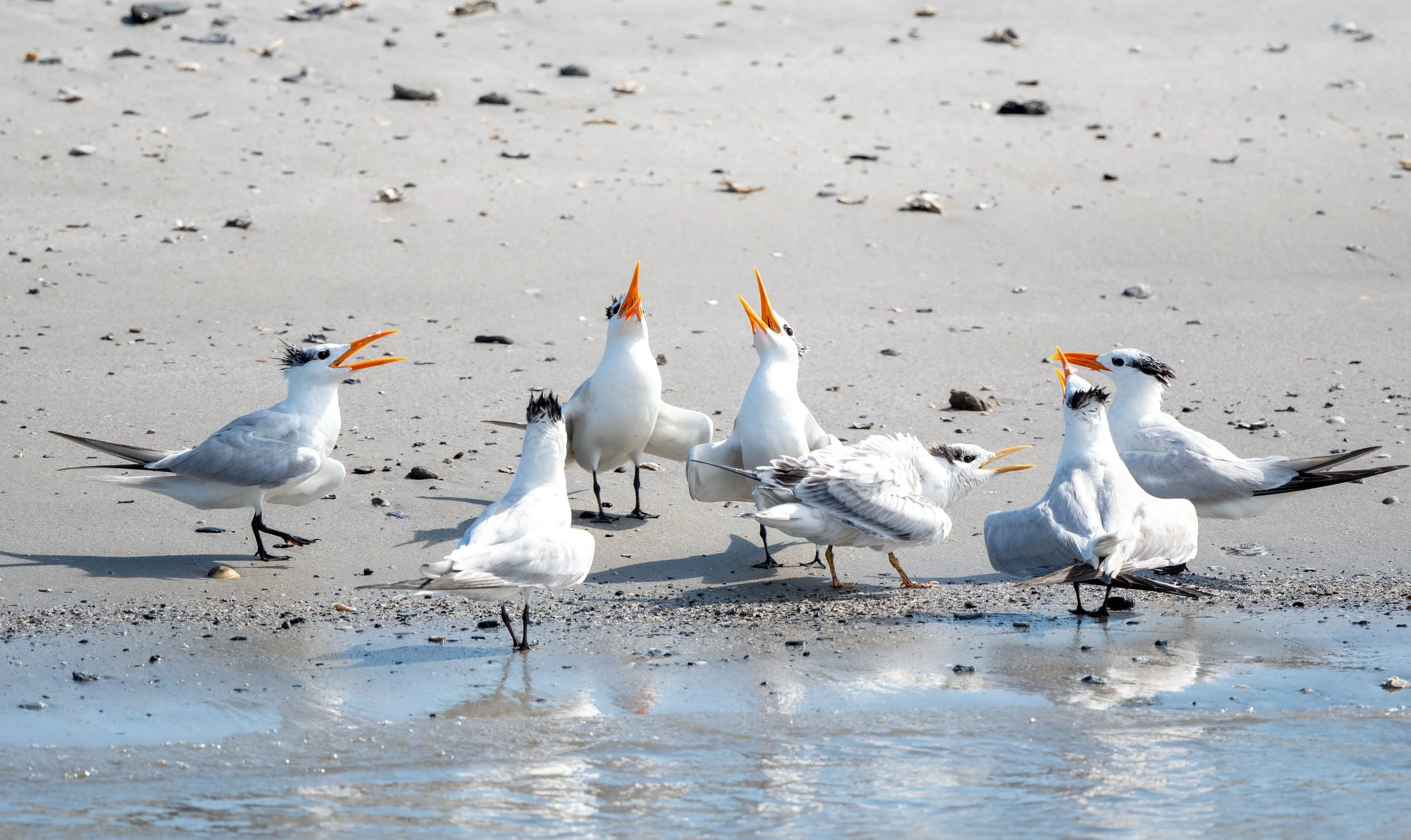
❋ DescriptionA noisy, highly social species characterized by a long, orange bill, a moderately forked tail, white underparts (and white forehead in common plumage), and gray wings.
❋ CallA loud, rolling “keer-reet.”
❋ DimorphismDuring breeding season, they will develop a fully black cap. Sexes are similar.
❋ JuvenilesHighly variable plumage; bill is typically smaller and pale yellow. Feet and legs black to green to yellow to pink.
❋ FeedingFeeds inshore along barrier beach oceanfronts and back bays; may range farther offshore. Opportunistic; eats fish and occasionally crustaceans - particularly shrimp. Plunge-dives to capture prey. Diurnal, but forages at night when the tides, moon, and wind are favorable.
DISTRIBUTION
❋ Population~165,000 individuals, with majority breeding in the eastern United States.
❋ RangeBreeds from coastal Massachusetts all the way south to Florida and the Gulf. Also found along the entire coast of Central America. On the Pacific side, they can be found from central California, down the west coast of Mexico and Central America, to as far as northern Chile.
❋ MigrationAfter breeding, North American populations will, uniquely, disperse northward to forage, then go southward to winter along the Atlantic and Gulf coasts. During the winter, they will migrate south as far as northern South America. South and southeastern populations may remain year-round.
❋ HabitatBreeds on barren sandy barrier beaches, saltmarsh islands, shell bars, dredge spoil, and coral islands. Avoids vegetation.
⛶ Cacky Rivers
-
Least Concern according to the IUCN.
-
Along with many other coastal birds, sea level rise, heat waves, and increase in rainfall/climate events all threaten survival of nesting habitat.
-
Seriously declined in the 1800s and early 1900s due to egg harvesting for food; like many other birds, the implementation of the Migratory Bird Treaty Act greatly improved its population numbers. Today, they are still vulnerable to loss of nesting sites due to erosion and human disturbance.
-
South Carolina is a breeding stronghold for Royal Terns. Undeveloped dredge-spoil islands are valuable nesting areas; one may see tern colonies nesting beside other colonial waterbirds during the spring and summer. Many populations will remain here year-round.
-
Sexual Behavior
Monogamous. Complex aerial behavior during courtship. May also involve presentation of fish to female.
Nesting
Extremely dense breeding colonies. Nests are often hexagonally packed in order to maximize space. Typically only lays a single egg, but may lay two in rare cases. Semi-precocial young.
Parental Care
Parental duties are shared by male and female. Will also form creches, which is essentially an avian nursery system in which offspring are cared for by multiple females.