
Passerines
Life Histories and
Human-Avian Dynamics
JUMP TO
PROTHONOTARY WARBLER • CEDAR WAXWING • MARSH WREN • PAINTED BUNTING • SEASIDE SPARROW
Research by Hannah Escalante
Prothonotary Warbler • Protonotaria citrea •
Prothonotary Warbler • Protonotaria citrea •
⛶ Kannan Sundaram
Prothonotary Warbler
Protonotaria citrea
Order Passeriformes, Family Parulidae
IDENTIFICATION
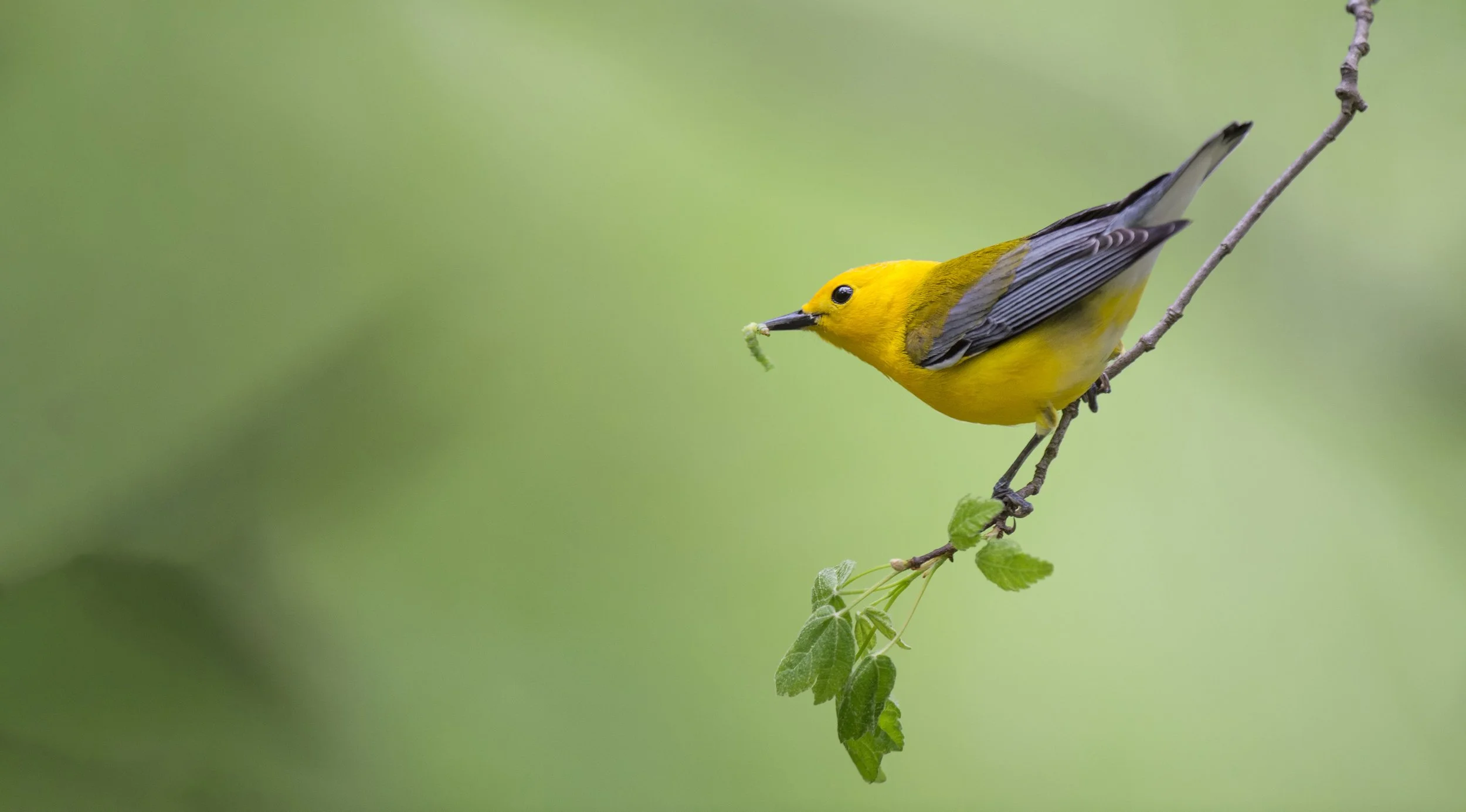
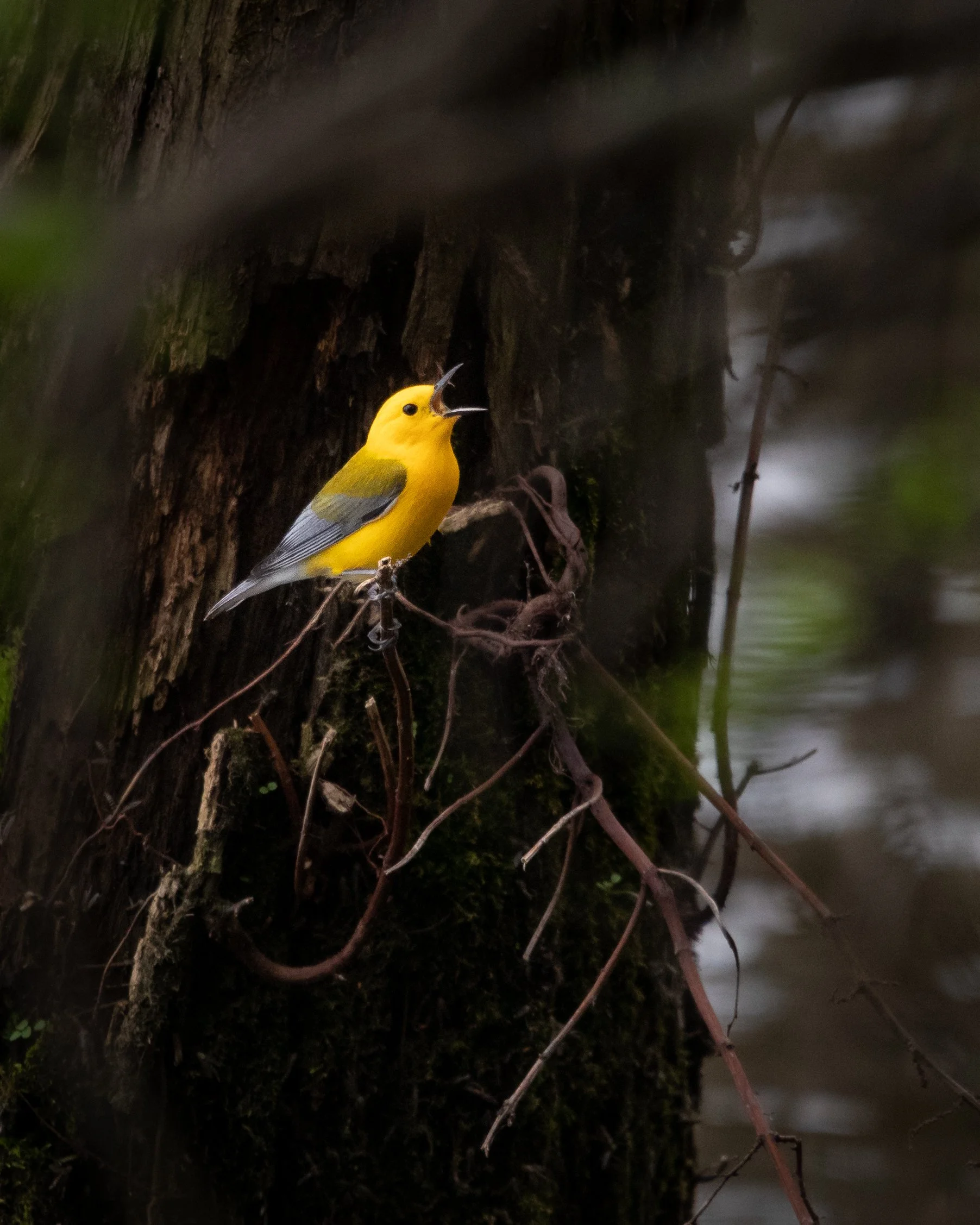
❋ DescriptionPronounced “pro-THA-nuh-teh-ree,” this wood warbler was named for its plumage, resembling the bright yellow robes of papal clerks (prothonotaries) in the Roman Catholic church. Fairly large for a warbler with a heavy body, heavy, pointed bill, and short tail. Has gray wings and tail, white lower belly, dull greenish back and bright yellow underside and head.
❋ CallA single syllable chirped 4-14 times in series, increasing in amplitude toward the end.
❋ DimorphismFemales may appear to be duller and will have more greenish olive on their crown, nape, and neck when compared to the males. In the Fall, males will have orange tints.
❋ JuvenilesBreast, head, neck, and upperparts grayish olive; face pale yellowish olive; belly whitish gray; olive wings.
❋ FeedingPrimarily insectivorous; also intake mollusks and isopods. In non-breeding season they may be more opportunistic, adding fruit, seeds, and nectar into their diet. During breeding season, diet includes mayflies. Gleans to capture prey. Diurnal.
DISTRIBUTION
❋ Population~2,100,000
❋ Range
Abundant in lowland wetland forests throughout the southeast United States; local and scattered throughout the northern states; absent in New England. Extends along the Gulf down the eastern coast of Central America to the northern tip of South America (as far down as coastal Ecuador and coastal French Guiana). Also seen migrating and wintering across the Caribbean.
❋ MigrationBreeds from southern New Jersey to north-central Florida, west to east-central Texas, central Oklahoma, and east Kansas. North American populations depart in late summer to mid fall to winter in the mangrove forests of Central and northern South America, arriving in late August to October. Also migrates and winters across the Caribbean.
❋ HabitatForested wetlands; near water in wooded areas with suitable cavity-nesting sites. Also tends to be low in elevation and flat in terrain.
-
Least Concern according to the IUCN. Considered moderately vulnerable to habitat destruction throughout migratory range.
-
Sexual Behavior
Monogamous, but males occasionally engage in opportunistic polygamy. In courtship, male flies close to female as well as will repeatedly enter and exit the nest cavity to signal interest.
Nesting
Only eastern wood warbler that nests in tree cavities; Often uses holes excavated by Downy Woodpeckers. Males will also guard females when they build their nest and lay eggs. Brood parasitism has been recorded, in which Brown-headed Cowbirds may lay their eggs in a Prothonotary Warbler nest in order to decrease parental responsibility. Will lay 4-5 eggs at a time, laying 1-2 broods per season.
Parental Care
Only females incubate; both parents feed young. Altricial young.
-
Small birds are not as efficient at maintaining body temperature, typically surviving only in a narrow temperature range. Knowing this, when this species migrates, small changes in weather patterns and/or temperature could be detrimental to their survival.
-
Holds a recent place in U.S. history by being part of the case and conviction of Alger Hiss, an American government official accused of spying for the Soviet Union. A previous friend of Alger Hiss - Whittaker Chambers - accused Hiss of espionage, which led to Hiss lying about knowing Chambers. Whittaker’s testimony involved admitting personal information in order to prove their past friendship, which included the claim that Hiss was an amateur ornithologist excited to spot a Prothonotary Warbler along the Potomac River. When asked later, Hiss admitted that he had indeed spotted this species along the river, building evidence to support the relationship between Chambers and Hiss. Richard Nixon also proved their relationship, leading to Hiss being convicted of perjury. Aside from its political involvement, this species is threatened by habitat degradation, destruction, and alteration due to its confined habitat preferences. Logging and agricultural conversion of such habitats have been detrimental to their populations - especially in northern South America, where the greatest number of the species winter. Despite this, they are very tolerant of human activity, sometimes foraging within 1-2 meters of humans.
-
With the help of a 9-year-old SC cub scout and many other voices in the community, the Prothonotary Warbler was named the state migratory bird of South Carolina in February 2026. The state provides critical habitat to the species, providing ~50,000 of these birds key nesting territory; one example of such a habitat is in the largest remaining old-growth Cypress Tupelo swamp in the world, at the Francis Beidler Forest. This species is both a figurative and literal symbol of our wetlands, their importance, and their protection.
Cedar Waxwing • Bombycilla cedrorum •
Cedar Waxwing • Bombycilla cedrorum •
Cedar Waxwing
Bombycilla cedrorum
Order Passeriformes, Family Bombycillidae
IDENTIFICATION
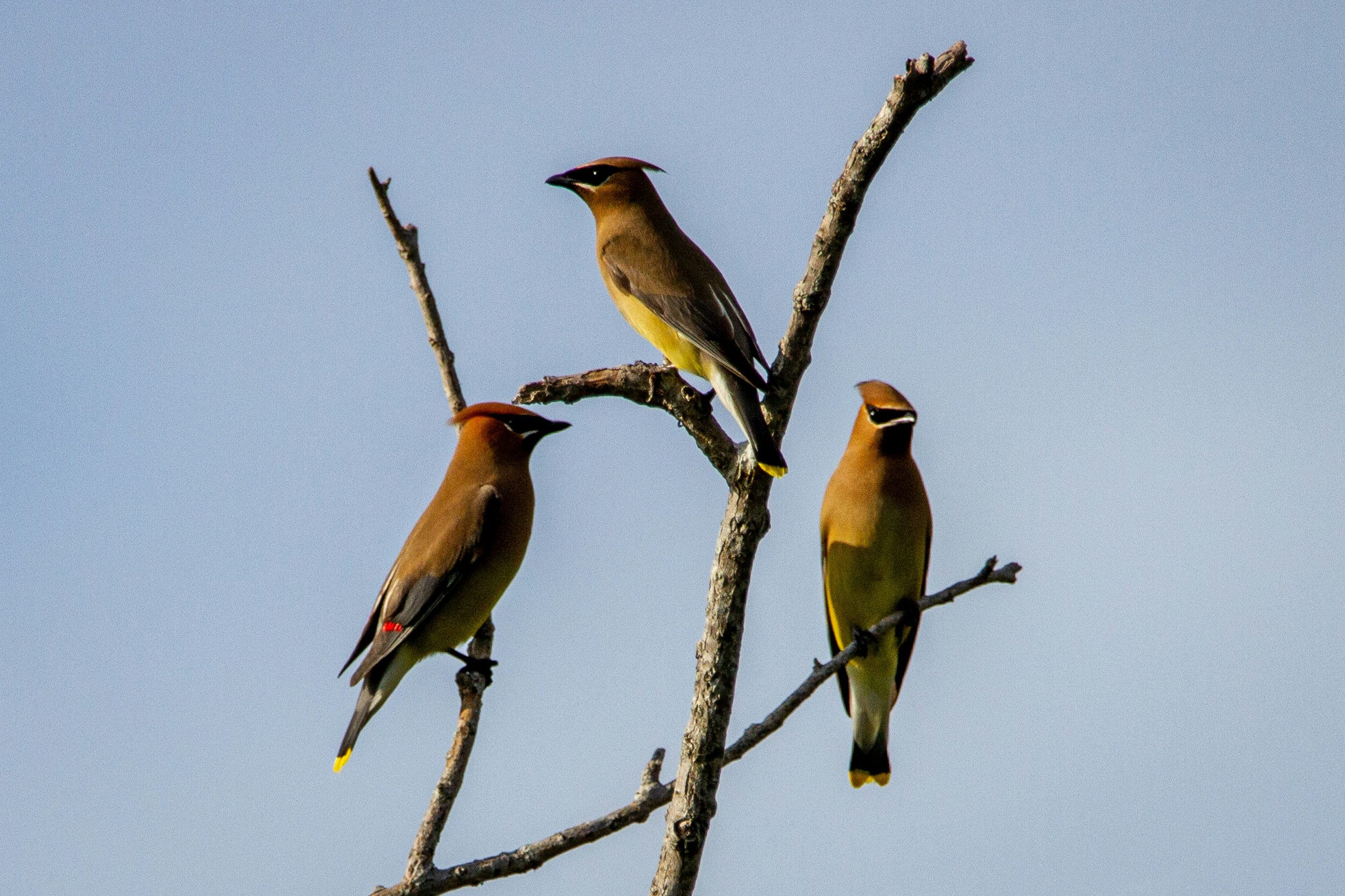
❋ DescriptionNamed for the red, waxlike tips on the inner feathers of an adult, the Cedar Waxwing is a familiar species in North America. Crested with overall gray-brown plumage. Have a sharp black face mask edged with white, black chin-patch, variable patches of red, and pale-yellow feathers on the belly. Have a distinct yellow band on the tip of their feathers. Bill, legs, and feet are relatively small.
❋ Call
Buzzy or trilled high-pitched notes made up of rapidly repeating elements. May also make high-pitched, hissy, tonal whistles.
❋ DimorphismMales have a darker, more extensive black chin-patch, though this is difficult to discern in the field.
❋ JuvenilesGrayer plumage overall; black mask may not be fully formed.
❋ FeedingAmongst one of the most frugivorous birds in North America; Forages in noticeably large flocks. Eats fleshy fruits, especially in the winter. Will glean insects from vegetation or sally. In recent years, this species has begun relying on fruits planted as ornamentals in landscaping. Diurnal.
DISTRIBUTION
❋ Population~64,000,000; has steadily increased over the past 20 years.
❋ RangeFound in Canada, every state in the U.S., and Central America. Breeds as far north as southeast Yukon in Canada to the western Carolinas. Winters from this point downwards to Central America, as far south as central Panama.
❋ MigrationHave lower levels of return to former breeding habitats when compared to other passerines. Migratory flocks will begin forming in August, departing from northern regions of breeding range in late August to October to migrate to wintering territory. Spring migration is difficult to track due to inconsistent return to breeding territory, but one will typically see hundreds (sometimes thousands) of birds in a flock breed in late May.
❋ HabitatRelies on habitats with fruit-bearing shrubs and small trees. Typically resides in open woodlands and shrubby fields. They are important seed dispersers, having a mutualistic relationship with fruiting plants. Because of this, they facilitate the development and maintenance of their own habitats.
⛶ Joshua J. Cotten
-
Least Concern according to the IUCN.
-
Sexual Behavior
Monogamous. Mates alternately approach one another on a perch with hopping movements, sometimes touching bills. Typically initiated by males. Male may also bring food to female during courtship.
Nesting
Female conducts the majority of the nest. Typically lay around four eggs with 1-2 broods per season.
Parental Care
Parental duties are typically taken by the female. Altricial young.
-
Because this species follows and, in a way, can control their foraging source, they have high adaptability to changing conditions. This makes this species one of the few species on this document that could be considered somewhat resilient to climate change.
-
Cedar Waxwing populations are theorized to be increasing due to habitat changes caused by human activity. With urban planting, forest and shrub regeneration, and establishment of agricultural fruit crops, this species may be gaining additional habitat and foraging territory. However, due to their diet, they are especially vulnerable to pesticide exposure. It has also been noted that Cedar Waxwings are especially vulnerable to collisions with windows.
-
This species can be found filling the trees of the Lowcountry as they winter in flocks. They are an unmistakable species that, with their distinct plumage, can make a barren tree appear full with yellow and brown from a distance. Though important seed dispersers, they are also known to disperse invasive plant species such as non-native honeysuckle.
Marsh Wren • Cistothorus palustris •
Marsh Wren • Cistothorus palustris •
Marsh Wren
Cistothorus palustris
Order Passeriformes, Family Troglodytidae
IDENTIFICATION
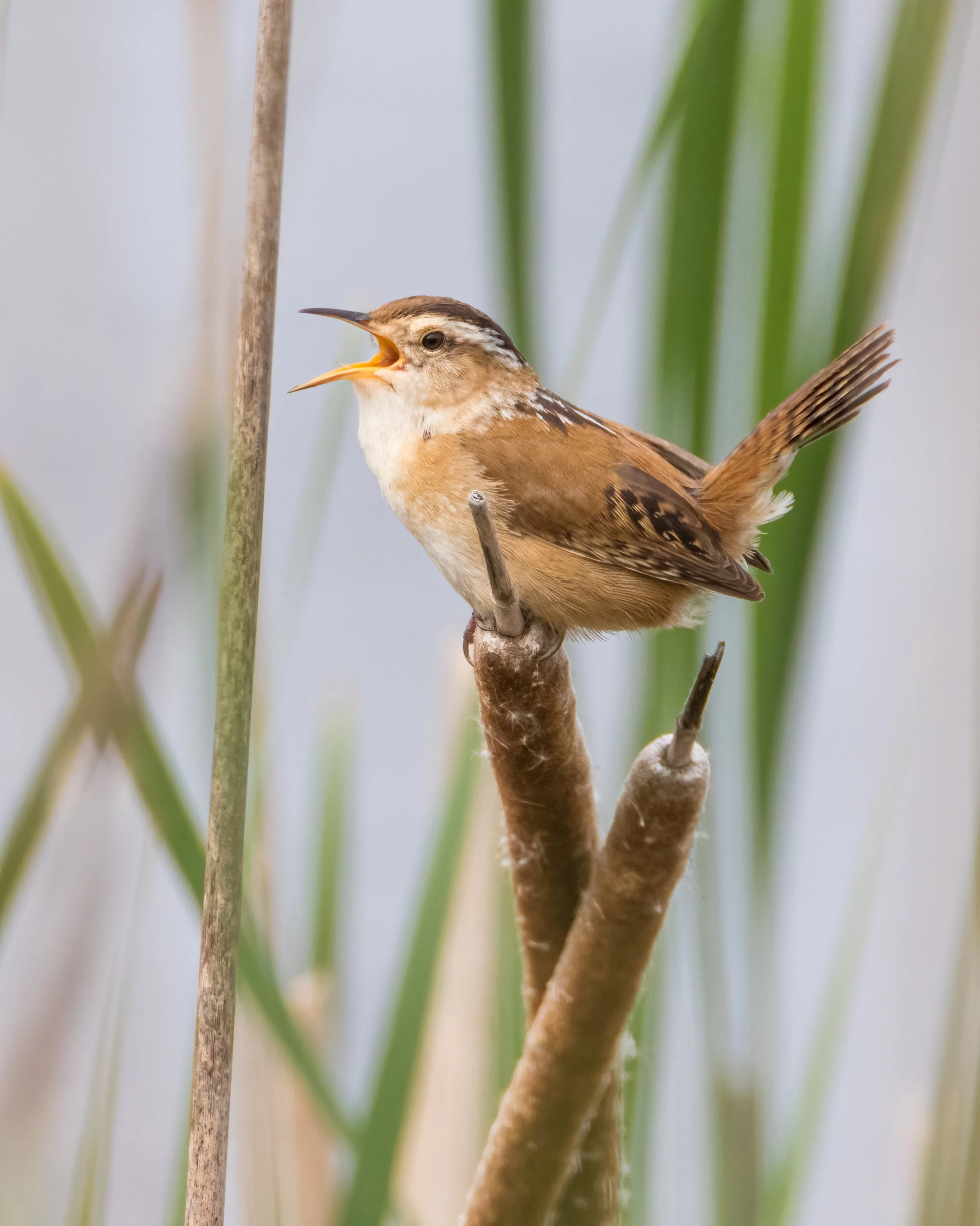
❋ DescriptionA true songbird of the marshes with a dull black crown, upper back with a black triangular area striped with white, cinnamon brown or rusty upperparts with occasional black barring, and whitish below.
❋ CallMore often heard than seen; only males sing. Have quite a large variety of calls. There is experimental evidence that young Marsh Wrens can learn and imitate songs, though no vocal mimicry has been recorded in the wild. Neighboring males will engage in complex singing duels day and night. Audubon describes a call as the grating of a rusty hinge; some say it sounds like an old-fashioned sewing machine; and others say that it sounds like air bubbles forcing their way through mud.
❋ DimorphismMales are larger and heavier than females. Plumages identical.
❋ JuvenilesHas no white streaks on back and only a few black markings in comparison to adult.
❋ FeedingEats invertebrates, especially insects and spiders. Will eat aquatic insects in freshwater marshes. Opportunistic. Will typically forage on or near marsh floor out of view from humans. Almost always on the move, they will glean from any plant surface as well as at or below the water surface. Diurnal.
DISTRIBUTION
❋ Population~11,000,000
❋ Range
Can be found extending as far north as British Columbia, Alberta, Saskatchewan, and Manitoba in Canada. Found in every state in the U.S. and as far south as central Mexico.
❋ MigrationMigration is variable across range. Birds will begin landing in breeding territory from late March to May, which is typically in northern states and in Canada. Will leave to migrate to wintering territory in August. This includes Florida, the Gulf coast, all of Texas excluding the northeast, majority of New Mexico and Arizona, and down as far south as Central Mexico. Populations in the southeastern U.S. and portions of the Pacific coast are often resident year- round.
❋ HabitatReside in a variety of marshland habitats throughout North America; both freshwater and saltwater. Will climb up and down emergent vegetation.
-
Least Concern according to the IUCN.
-
Sexual Behavior
Polygamous, with one male typically choosing greater than one female. Mate choice by female is dictated by nesting habitat/display. Flying over to each other's territory and exhibiting calls and bows are also a part of courtship.
Nesting
Males will build at least half a dozen unused “dummy nests” for every breeding nest used by a female. Will also habitually destroy eggs - both their own species and of other species - likely due to the intense competition that exists in a marsh habitat. Will typically lay 4-6 eggs, but can range from 3-10 eggs.
Parental Care
Female is responsible for all parental care. Altricial young.
-
The Marsh Wren’s preferred habitat is quite vulnerable to sea level rise and extreme weather, threatening the breeding, nesting, and wintering territory of the species throughout its range.
-
Significant numbers of Marsh Wrens are killed due to collision with tall structures. Additionally, throughout the range of this species, marshes have been destroyed, altered, restored, and/or created; the birds will respond accordingly. There is substantial evidence that this species will readily colonize in artificially made marshes. Despite this, it is still important to note that preservation and protection of these ecosystems should be prioritized.
-
Our coast supports Marsh Wrens year-round, serving as an important breeding, migratory, and wintering area. Abundant yet hidden in the reeds of the saltmarshes, the harsh calls of this species are familiar to residents of the Lowcountry. They typically lay their eggs around early June. Though hard to spot, these wrens dominate our wetland ecosystems, serving as an indicator of ecosystem health and a symbol of marsh elusivity.
Painted Bunting • Passerina ciris •
Painted Bunting • Passerina ciris •
Painted Bunting
Passerina ciris
Order Passeriformes, Family Cardinalidae
IDENTIFICATION
❋ DescriptionWhether seen as brightly colored with blue, green, and red or more cryptic with dull green and yellow, the Painted Bunting is a beautiful songbird that inhabits the thickets and shrubs of the Lowcountry.
❋ CallOnly males sing; a sequence of high-pitched syllables with high and low tweets.
❋ DimorphismAdult males and females differ strongly in plumage. Adult males have a blue head and nape, bronze-green back, red rump and underparts, and dark wings and tail. Adult females present more cryptically, having dark greenish upperparts and yellow green underparts. Males experience delayed plumage, and will present in female plumage until the fall of their second year. In this period of time, males can be distinguished from females by breeding behavior, in which males sing and females do not.
❋ JuvenilesPresent as a smaller, more dull female.
❋ FeedingWill eat seeds, but will switch to arthropods for breeding season during spring and early summer. Will extract arthropods from spider webs and forage off the ground. Diurnal.
DISTRIBUTION
❋ Population~13,000,000
❋ Range
Can be found breeding in Kansas, Oklahoma, Texas, Arkansas, Louisiana, and coastal Carolinas, Georgia, and northern Florida. Migration and wintering populations are found from coastal Mexico states to central Panama.
❋ MigrationWestern populations migrate to staging areas in southern Arizona and northern Mexico, then continue to winter from coastal Mexico states to as far south as central Panama.
❋ HabitatSwampy thickets and woodland edges. Shrubs, maritime forests.
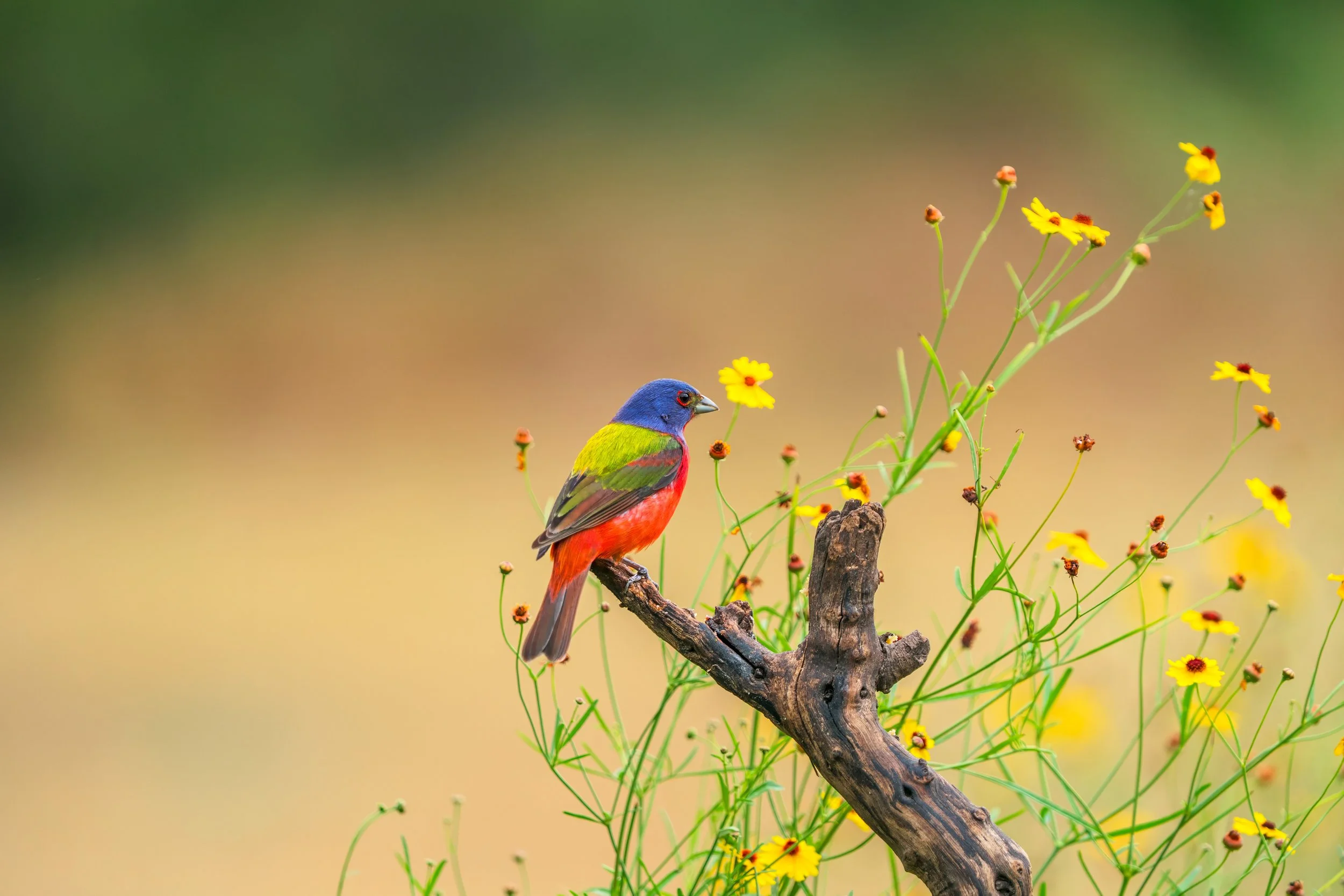
⛶ Denise Johnson
-
Least Concern according to the IUCN; species of Special Concern by Partners in Flight. Breeding Bird Surveys have documented significant regional declines, most especially along the Atlantic coast.
-
Sexual Behavior
Mostly monogamous but some polygamy. Males will spread wings and tail and fluff their plumage - almost like a miniature turkey - to court females.
Nesting
Strongly territorial in breeding season. Will “wing-quiver” when threatened, raising tail about 45 degrees and lowering wings as they quiver. Females will build a sturdy nest lined with hair or fine grass. Will lay 3-4 eggs. Brown-headed Cowbirds will commonly lay their eggs in a Painted Bunting’s nest as a form of brood parasitism.
Parental Care
Only female provides care. Altricial young.
-
Because this species is already in decline in many regions due to habitat loss or urbanization, the effects that climate change could have on their preferred tidal habitats could be amplified.
-
This species’ preferred habitat has faced extensive loss and degradation - most especially along the Atlantic coast - due to urban development. Additionally, due to their bright plumage, Painted Buntings are commonly trapped and sold in large numbers in the Caribbean and Central America. Audubon reported that thousands are caught each spring and are being transported to Europe as well.
-
This species is most especially abundant in this state, with high breeding densities dominating the coastal Lowcountry’s shrubs, marshlands, and forests. Unfortunately, South Carolina has played a somewhat negative role in this species’ conservation story with an increase in coastal development. Audubon, SCDNR, and local nonprofits have taken steps towards conservation through increasing research, education, and advocacy for habitat protection.
Seaside Sparrow • Ammospiza maritima •
Seaside Sparrow • Ammospiza maritima •
Seaside Sparrow
Ammospiza maritima
Order Passeriformes, Family Passerellidae
IDENTIFICATION
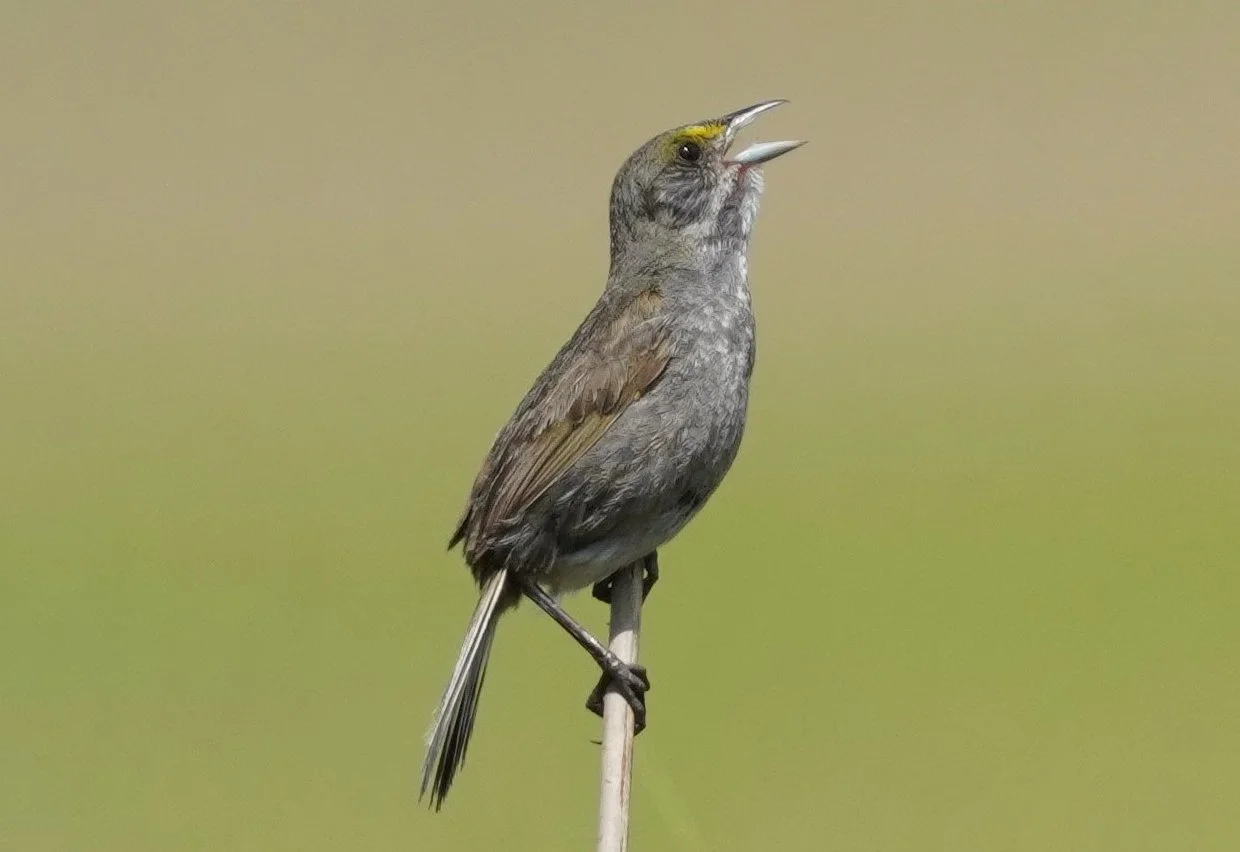
❋ DescriptionThis marsh specialist can be seen with a distinct yellow spot from beak to above eye. Bill is long but conical. White throated with streaks of gray, brownish black, and black on their breasts and sides.
❋ Call
A single buzz note layered with many different pitches/frequencies, almost like a cicada. Almost resembles a Red-winged Blackbird, but is less strong and higher pitched.
❋ DimorphismNo observed dimorphism.
❋ JuvenilesAre paler and buffier than adults and have very sharply defined streaks.
❋ FeedingDuring the breeding season, they will eat insects and spiders. While wintering, they will eat seeds, insects, spiders, crabs, mollusks, and marine worms. Mainly feed in open spaces with vegetation by probing or occasionally gleaning. Strong, large foot is adapted for clinging to upright stems of grass.
DISTRIBUTION
❋ Population~200,000
❋ Range
Relatively narrow range restricted to the coast; can be found from New Hampshire south down to Florida and along the Gulf, ending at Texas.
❋ MigrationNortheastern populations are short-distance migrants that will move south to winter (as far down as Florida) from August to October. Southeastern populations including South Carolina as well as Florida and the Gulf coast are nonmigratory.
❋ HabitatA specialist in salt and brackish marshes; tidal marshes with expansive cordgrass.
-
Least Concern according to the IUCN. The vulnerability of this species varies in each region, but many states - especially coastal - have classified them in a state of high vulnerability.
-
Sexual Behavior
Monogamous. Male will follow female, calling and raising wings until female reciprocates.
Nesting
Begins in May in northern populations and as early as March in Florida. Nesting habitat is very susceptible to flooding; Spring tides determine lower point of nest placement. Repeatedly renests after nesting failures, and will lay 2-5 eggs. Nest is woven with grass.
Parental Care
Only female incubates, but both parents feed. Altricial young.
-
With an increase in the chance of extreme weather events and tides, nesting habitat loss due to flooding and sea-level rise is a great concern for this species.
-
This species’ primary threat is habitat modification, disturbance, and habitat loss; more specifically, filling, draining, and pollution have been noted as anthropogenic factors. When in groups, this species can be somewhat resilient; however, habitat protection alone may not be sufficient enough to prevent local extinctions from small populations, and management intervention may be necessary.
-
As a city and state that places high value on their marshlands, this species occurs year-round. The Seaside Sparrow is designated as High Priority by SCDNR, especially due to its reliance on endangered habitat. As they are entirely confined to marsh ecosystems, they serve as important bioindicators.